Tuesday, October 18, 2011

Occupy World Street ....


Occupy World Street ....
By Pepe Escobar


... if the enemy wins, even the dead won't be safe.
And this enemy has not stopped winning.
- Walter Benjamin, On the concept of History....
CIA informants inside OWS movement in NYC....


In a page taken right out of the FBI's Counter-Intelligence Program (COINTELPRO) and the CIA's domestic spying operations from the 1960s, a handful of long-time CIA operatives have been detected among the key leadership of the Occupy Wall Street (OWS) movement in New York.

The CIA's penetration of OWS comes at the same time that a longtime CIA clandestine services officer, with field experience in Jordan and Pakistan, has been identified as a special assistant to the deputy commissioner of intelligence at the New York Police Department. The CIA agent has been assigned to his NYPD duties since July. The stationing of the CIA liaison officer at the NYPD has the approval of CIA director David Petraeus.

Two former CIA officers, David Cohen and Larry Sanchez, helped establish the NYPD's new intelligence division. Sanchez left the NYPD in 2010 while Cohen remains as the Deputy Commissioner for Intelligence. After retiring from the CIA but before taking his present job, Cohen worked for the "too-big-to-fail" American International Group (AIG), a company with longstanding links to the CIA, particularly in Asia....


The Indignados International rules. The torch has been passed from Cairo's Tahrir Square (the Arab Spring) to Madrid's Puerta del Sol (the Spanish Spring), on to New York's Liberty Square (Occupy Wall Street) and from this past Saturday on, World Street - 951 cities in 82 countries.

All ages, all social classes - but mostly brave young men and women denouncing the hubristic fall of large swathes of the world

into a geopolitical abyss trespassed by an unprecedented social, financial, monetary, political and strategic crisis.

Nothing is more natural than "we are the 99%" going global - because the movement specifically denounces the ravages worldwide caused by the myth of neo-liberal globalization, as applied by that wrathful God, The Market. Yet the 1% - and their corporate media shills - still don't get it (or mock it), and will try to smash any actions to remedy neo-liberalism's utter failure.

The 1% cannot possibly understand the anger of a "no future" generation, or the anger of those who have played the game by the rules and ended up with nothing - the collective anger of all who cannot possibly trust failed political and financial institutions anymore.

And it will get worse. Banks are not lending and reactivating the economy mostly because in the US, only four giants - Goldman Sachs, JP Morgan Chase, Citigroup and Bank of America - now hold 95% of US derivatives, a whopping $600 trillion nightmare just waiting to happen. Derivatives were crucial in bringing down the global economy, with all its dire social consequences - and it may happen all over again.

Meanwhile, the 1% is in the process of violently assaulting the historical rights of working and middle classes - even at the risk of losing what's left of their political and social legitimacy (they don't care anyway). As Minqi Li, former Chinese political prisoner and economics professor at the University of Utah stresses, "As during the 1968-1989 period, the resolution of the crisis will depend on the evolution of class struggle on a global level." Li insists that capitalism is not part of the feasible options left; but the problem is the solid 1% elites are still in control, and will relinquish power over their dead collective body.

Creating a new political language
So what next? Where to go from here? Where to find the intellectual firepower to keep fighting?

At Zuccotti Park - Occupy Wall Street's headquarters in lower Manhattan - there's a free public library, with books donated by everyone who feels like it. A good first step would be for people to supply a good many copies of The Beach Beneath the Street, by McKenzie Wark [1], a gripping history of the Situationists - the key conceptual group led by Guy Debord at the heart of May 1968.

Wark has also written a clinical essay detailing how instead of occupying an abstraction - Wall Street - the movement occupied another abstraction, "A more or less public park nestled in the downtown landscape of tower blocks, not too far from the old World Trade Center site," and from there proceeded to occupy "the virtual space of social media".

Wark concludes, "The abstraction that is the occupation is then a double one, an occupation of a place, somewhere near the actual Wall Street; and the occupation of the social media vector, with slogans, images, videos, stories. 'Keep on forwarding!' might not be a bad slogan for it. Not to mention keep on creating the actual language for a politics in the space of social media."

No wonder the 1% are puzzled. Occupy Wall Street is already creating a new political language, smashing old categories of cause and effect, using for instance what Guy Debord described as derive - a technique of moving like lightning through different settings (from physical to virtual, or from lower Manhattan to Washington Square and Times Square).

They are already amplifying Gilles Deleuze and Felix Guattari's concept of rhizome - polishing an interdisciplinary, underground, symbolic war machine.

As a grandson of May 68 and the Situationists, Occupy Wall Street could not but be radical. It wants to go beyond power politics, corporate power and corporate cronyism. It won't be bought - a key reason for it to be relentlessly mocked by corporate interests (who cares about corporate behemoths Time Warner and Rupert Murdoch's News Corporation? Occupy should let them rot in irrelevancy). It's essentially a collective rebellion of people - neither left nor right, but certainly not conservative - who refuse to be co-opted (and hopefully will treat opportunists like Al Gore, Warren Buffett and George Soros like the plague).

What do they want? They want the common good to be available for all - not privatized to death or exploited by corrupt political castes. How the common good - the water, forests, communication networks, factories, transportation networks, hospitals - should be used is up to the citizens of each local, contemporary Agora (the Greek popular assembly place). That, essentially, means putting people first - the absolute antithesis of the mercantilization of life.

This is a utopian agenda - and what makes Atlanticist right-wingers squirm, it's a direct call to utopian communism. Titus Levi, a professor at the United International College in Zhuhai, southern China, calls it "commonism"; he reflects how "having an economics of biology and humanity turns the current system on its head: using economics as a tool for humanity, not humanity ground down to serve economic imperatives."

Occupy World Street certainly wants that forests won't be mowed down, the air won't be polluted, banks won't be double-crossing their clients, and citizens should be totally engaged in the running of public life (and not resign themselves to vote under appalling electoral laws every four or five years). This implies sensible laws managed by honest and impartial people should be in place. It's not happening - thus the swelling ranks of the Indignados International.

Look south, young man
Occupy Wall Street could also use a kick-ass manual of radical politics such as Hermeneutic Communism [2], by Gianni Vattimo, professor of philosophy at the University of Turin, and Santiago Zabaleta, research professor at the University of Barcelona.

In action-packed 140 pages - plus copious notes - Vattimo and Zabaleta eschew historical Soviet communism and the contemporary Chinese model to praise the present, democratically elected, South American governments, "which are determined to defend the interests of their weakest citizens."

They are certainly right to believe that "this is the region of the world that best represents the communism of the twenty-first century, which, as Eric Hobsbawm said, must be first and foremost a critique of capitalism"; or a defense of what the great Walter Benjamin called "the tradition of the oppressed".

Vattimo and Zabaleta produce a devastating critique of our "framed democracy", in which the 1% "pursues truth in the form of imposition (violence), conservation (realism) and triumph (history). These metaphysically framed political systems hold that society must direct itself according to truth (the existing paradigm), that is, in favor of the strong against the week".

Vattimo and Zabaleta naturally debunk the whole "end of history" fallacy as well as demonstrate "how within the system of metaphysically framed democracies, change is almost impossible". The only possible alternative left at the moment is in the Latin and especially South American space, where, to quote Noam Chomsky, "People just take democracy more seriously than in the West, certainly the United States."

As imperfect as the different national experiments may be, from Brazil to Venezuela, from Bolivia to Argentina, at least the new South American governments have been more representative of their people because "they have been detaching themselves not only from neo-liberal impositions but also from the attendant military presence, that is, armed capitalism".

So Occupy the World has much to gain by analyzing the different political experiments in South America. Parallels with Europe are also very enlightening. Compare for instance Argentina - where in the next elections on October 23 Cristina Kirchner will be most certainly leading a third post-neo-liberal term, just like Dilma Rousseff in Brazil - to Spain, home of the indignados, where, believe it or not, the reactionary, quasi-fascist Popular Party is bound to win the November 20 elections.

The reptilian former Spanish Prime Minister Jose Maria Aznar has described the indignados as a "marginal, non-representative" movement - just as your average Fox News anchor.

Make no mistake; the intellectual firepower to channel global anger is there, from Vattimo and Zabaleta to Deleuze and Guattari, from Debord and Benjamin to David Harvey and Eric Hobsbawm, from Alan Badiou and Slavoj Zizek to Minqi Li and Wang Hui, from Atilio Boron to Bolivian Vice President Alvaro Garcia Linera.

This is not a (global) revolution - yet; it's still (slow) evolution. The post-political silent majority is certainly not stupid - just cynically resigned. The challenge is to hurl them out of their couches and remotes and into the streets - to make it a 99% in action.

That implies pressing for a number of key, specific policies; taxing the wealthy and the financial system, more funds for public education, decent health care, the end of the Pentagonization-addicted worldwide US Empire of Bases. As far as the US is concerned an overwhelming majority of Americans is in favor of these policies.

So the answer, my friend, is and will be blowing in the streets. All power to the Indignados International. It's time to remix Martha and the Vandellas for the early 21st century. Calling out around the world, are you ready for a brand new beat?

Notes
1. See here. 2. See here.

Saturday, October 15, 2011

Zioconned Turkey awaits the Arab Spring....


Zioconned Turkey awaits the Arab Spring....
By M K Bhadrakumar

The Arab Spring has apparently had no impact whatsoever on Europe's entrenched views on Turkey. This much becomes clear from the annual report of the European Commission (EC) on Turkey issued in Brussels on Wednesday. The report took stock of Turkey's reform program in terms of its membership bid of the European Union (EU) and roundly censured the country over human rights and its increasingly acrimonious spat with Cyprus.

Conceivably, the EC report mummifies for a long time Turkey's EU bid, which has spluttered in the past year or two. To add insult to injury, the EC gave the green light to two of Ottoman Turkey's "grandchildren" in the Balkans - Serbia and Montenegro - on their respective aspirations to join the European club.

Recent months have been a heady period for Turkey, which has

convinced itself that the new Middle East taking shape in the upheaval of the Arab Spring would find it irresistible as a role model, and that the Western world would inevitably be compelled to revise its opinions and view Turkey in an altogether new light as the torchbearer of enlightenment in the Muslim world.

Wednesday's EC report comes as a reality check. The more things seemed to change, the more they remain the same. The EC report chastised Turkey about the lack of freedom of expression, women's rights and freedom of religion as falling below accepted standards in the liberal democracies of Europe. It estimated that the shortfalls continued to disqualify Turkey from joining the EU.

In a scathing reference, the EC report said, "In Turkey, the legal framework does not yet sufficiently safeguard freedom of expression. The high number of legal cases and investigations against journalists and undue pressure on the media raise serious concern."

Worn-out lens
The harsh criticism by the EC comes as an embarrassment when the leadership of Prime Minister Recep Tayyip Erdogan has been riding the wave of the Arab Spring in the Muslim Middle East and exhorting the Arab world to follow Turkey's unique example of combining or reconciling - depending on one's point of view - Western-style liberal democracy with Islam.

During his recent visit to Cairo, an assertive Erdogan crossed the Rubicon of Islam and gave audacious advice to the Egyptian people about the virtues of secularism - at a juncture when the Muslim Brotherhood is surging in that country and could be at the threshold of entering the corridors of power.

Curiously, the EC report has been received with ennui in Turkey. As prominent editor Murat Yetkin put it, "The truth is that fewer and fewer people in Turkey care about what the EU is saying on the country day by day." Yet, Turkey's Minister for Europe, Egemen Bagis, responded polemically to the EC report and alleged that the human-rights record of many EU member countries couldn't be "half as good as Turkey's".

He said the EC report was simply out of focus:
Although the report tries to take an objective and balanced picture of Turkey, we think that the camera used by the commission is old with a worn-out lens and the lens needs to be changed, as the picture has taken lots of blurred parts and the camera seems to be zooming on the false points.
Bagis maintained for the record that Turkey would not be detracted from its chosen path of an EC-membership bid. However, he added the caveat that "full membership is Turkey's only goal, no other goals can be accepted". Turkey bristles at the "privileged partnership" that has been mooted by France and Germany as an alternative to regular membership.

Objectively, the EC report is fair and balanced. It commends the Erdogan government for initiating civilian supremacy over the military, is supportive of his agenda to draw up a new constitution and even praises Turkey's economic policies. On the other hand, it flags Turkey's poor record of individual liberty and civil rights, the rule of law, freedom of expression, women's rights and the erosion of the autonomy of regulatory bodies. "Significant further efforts are required to guarantee fundamental rights in most areas."

However, these European perspectives don't surprise Turkey. The common perception in Turkey is that Brussels keeps coming up with excuses for not admitting Turkey into what is essentially a Christian club. The EC decision to encourage the membership bid by Serbia and Montenegro and to leave Turkey's accession hanging will only reinforce the grouse of "cultural" discrimination toward Turks.

The latest EC report may also have shifted the goal posts by introducing a new template, namely, Turkey's latest acrimonious rift with Cyprus, which erupted over gas deposits in the Eastern Mediterranean.

The report criticized Turkey for its strong reaction to the recent gas drilling by Cyprus in the Eastern Mediterranean and for carrying the rift to a potential flashpoint by starting its own seismic exploration in the region under a Turkish naval presence. It demanded that Turkey should make progress in normalizing relations with Cyprus and avoid "any kind of threat, source of friction or action that could damage good neighborly relations and the peaceful settlement of disputes".

Evidently, the new assertiveness in Turkey's regional policies is not going down well in European opinion. In addition to Turkey's showdown with Cyprus, European countries have been urging Ankara to address the tensions in its relations with Israel, but Erdogan has been in no mood to listen, and the rupture with Israel happens to be the one issue that has probably overnight made him a hero on the Arab street, while it has cost Turkey virtually nothing.

Europe always took with a pinch of salt Turkey's claims to play a leadership role in its surrounding regions. It sidelined Turkey's swagger in the Balkans in the project over the disbandment of Yugoslavia; more recently, France initially didn't even invite Turkey to the conclave discussing the Western intervention in Libya, although Arab countries were invited.

Tunisia surges
Most certainly, Europe (especially France) will ignore Turkey's claim for any leadership role in Syria or the Levant, leave alone in the Maghreb region. The vocal supporter of Turkey's regional leadership of a democratic Middle East happens to be Saudi Arabia and it has a special interest in doing so. French President Nicolas Sarkozy went to the Caucasus recently and put down Turkey rather harshly in an unwarranted display of derision.

The paradox, as the EC report implies, is that Turkey's own exciting reform program has ground to a virtual halt in the recent past, while Erdogan has been exhorting the Middle East to reform. Thoughtful Turkish commentators realize this contradiction. One of Turkey's most respected political observers, Sedat Ergin, drew attention to this in a column this week titled "The problem of fine-tuning policies on Syria".

Ergin wrote, "As soon as the winds named 'Arab Spring' started blowing, [Turkey] took the stance supporting the demands for change and democracy." Turkey's choice, he argued, was and is essentially correct, but a contradiction nonetheless arises when Turkey expresses such robust opinions favoring democratic reform. Ergin pointed out:
The Syrian regime's actions against the opposition groups coincide with a time when Peace and Democracy Party [Kurdish political party] members are being subjected to mass arrests, when elected deputies are kept in jails and when the space for the Kurdish political movement to operate within democratic bounds is being entirely constricted in Turkey.
Credit must be given to Erdogan that such frank discussions on the Kurdish problem are possible at all in today's Turkey, whereas, before his advent to power, the Kurdish problem itself used to be forbidden terrain for public discourse. All the same, the past two years have been more or less barren, and Erdogan was even regressive on the democratization front despite being so advantageously placed in Turkish domestic politics.

Erdogan needs to pay heed to the EC report when it gently underscores that Turkey is neglecting to do its own homework while immersed in espousing the cause of democratization in the Middle East. Out of the 35 chapters of the EU's Acquis Communautaire that Turkey is expected to comply with to gain membership, negotiations have begun on only 13 chapters in the entire period since 2005 when the accession talks began under Erdogan's stewardship.

The EU, it increasingly appears, was actually the driving force behind Erdogan's democratization program, and today the disconcerting reality is that Turkey may be losing interest in the EU membership project. A leading Turkish columnist, Semih Idiz, summed up the mood:
Turkish-EU membership talks are currently at a standstill, with little prospect of being revived soon ... EU is not something the majority of Turks look to with confidence or enthusiasm anymore ... The average Turk is aware of the obstacles strewn on Turkey's path ... Put another way, the "EU stick" simply does not work anymore ... because the "EU carrot" is not enticing for Turkey anymore, especially at a time of turmoil in Europe itself.
Indeed, Turkey's resounding success as an economic power-house during Erdogan's rule and the crisis shaking the European economies do present contrasting pictures that are misleading public opinion that Turkey could as well do without EU membership. No doubt, the EU's political leverage on Turkey is diminishing.

If so, where will a fresh impetus for reform come from? The Turkish official claim is that the government has an innate urge to reform the country, no matter the EU membership bid. But that isn't a convincing enough argument. So, could it be from the Arab Spring, which, ironically, Erdogan is charioting abroad?

As Tunisia heads for an historic poll on October 23 to elect an assembly that would frame a new constitution, Islamist leader Rachid Ghannouchi stole a march over Erdogan by fielding as candidate for the Ennahda party in the capital, Tunis, a woman who does not wear a head scarf. Even after nearly nine decades of constitutional rule, Turkey has not reached a comparable point.


Wednesday, October 12, 2011

“Neoconservatives” are the masters of political manipulation, war crimes and cowardly assassinations.....


“Neoconservatives” are the masters of political manipulation, war crimes and cowardly assassinations.....


The future of the world has literally been determined by the choices of one man, George Bush. The course he has decided upon in the American/Israeli Global War On Terrorism (GWOT) has set a new course for all mankind, for many years to come. Because it seems apparent that President Bush intends to escalate his Israeli-centric military policies, which many of us consider to be failed policies, it is incumbent upon all moral individuals to consider what these policies are, where they came from, and where they are leading us all to. The only information we have on our government’s secret war moves comes from the foreign presses, anywhere outside of the mainstream American press. The Internet is the only resource that provides access for most of us to this uncensored news source. The following series of Internet reports were generated while researching the covert foreign policies that form the backbone of the US terror war, focusing upon the groundwork that went into preparing the way for introducing a credible new “terrorist” enemy (after the demise of the Soviet Union) and the justification of the implementation of draconian measures on the home front to protect national security, as warranted by the new enemy.

Understanding Reality From Deception in the War on Terror

By: Peter Chamberlin
The propaganda war is the most important front in the terror war. “Neoconservatives” are the masters of political manipulation who sold the war to the people. This overwhelmingly Zionist movement rode to power in America on the efforts of other Zionist psychiatrists and sociologists, who had been implementing government brainwashing and psy-ops, to condition the American people to accept the new “war of civilizations” and the anti-Islamic policies that had been designed to support it and to bring it about. (See:
“The Zionist Brainwashing of America”)

Neoconservatism is a racist Nazi-inspired fascistic doctrine for implementing the Zionist plan to establish Israeli dominance over world affairs. The Neocon takeover of Jewish-American political affairs has created an anti-Semitic (anti-Arab) ideology for fomenting an international war between Muslims and Christians. (See: “Neoconservatism – Fascist Zionism”)

The political struggle between the neocon proponents of perpetual war and its opponents in the United States will likely determine the future course of the world. If the intended course is intended to create a state of permanent war, to accommodate American and Israeli military dominance, then all moral beings have a duty to humanity to oppose these forces. The struggle to expose our government’s use of terrorism abroad to influence politics here at home is a battle that must be won, to avoid the plotted fascist world order. (See: “The Ideological Struggle of the Twenty-first Century”)

The neocon war plan brings American foreign policy under Zionist control, making the interests of the government of Israel our primary concern, as America submits to international Zionists seeking to submerge us in their new world order. The plan for world conquest centered upon establishing Israeli world dominance is the fulfillment of centuries of work by dedicated Zionists, working to deceive the world, while taking it over. (See: “World War Three”)

The war on terror utilizes terrorism as a tactic for identifying the local minority which would resist American aggression, in order to eliminate that minority by military means.

(See: “Bombing Improper Thoughts”)

The original American “war on terror,” launched in retaliation for the terrorist attacks of September 11, 2001, has been supplanted by a substitute mission, one committed primarily to establishing Israeli security and merging American/Israeli interests.

(See: “Bait and Switch”)

American politics have been overtaken by a Christian/Zionist alliance dedicated to bringing-about a situation resembling the Biblical “end of the world.” In the name of fulfilling prophecy, they are actively supporting criminal Israeli actions and abetting the destruction of the Mideast “peace process.” (See: “Judgment Day”)
The assassination of Benazir Bhutto in Pakistan has many similarities to the conspiracy to kill JFK. CIA spokesmen have once again fingered a desired patsy in the person of local leader Baitullah Mehsud, as an attempt to further the al Qaida myth as justification to the American people for escalating the war there against the will of the Pakistani people. (See:
“A Grassy Knoll in Pakistan”)

The myth of al Qaida’s prowess is spread primarily through deceptive propaganda, much of it given directly as disinformation by “retired” CIA agents. (See: “CIA Agent Sees Dead People”)

The international terrorist organization known as “al Qaida” is a CIA/ISI (Pakistani secret service) creation, whose members were drawn from the ranks of Muslim jihadis that have been recruited by the United States and the Saudis and flown to Afghanistan. These proxy Islamic forces have staged terrorist attacks upon mostly Muslim civilians on behalf of the United States, working for every American administration since Reagan, killing civilians in a dozen or more countries to advance American foreign policy. The history of American, Pakistani, Saudi and Israeli secret services in the creation of al Qaida and its deployment in previous covert operations makes it obvious that there was some degree of complicity between these agencies and the al Qaida agents utilized in the 2001 attack upon America. (See: “Unraveling the Myth of Al Qaida”)

The neoconservative movement was a well-funded organized conspiracy to carry-out a coup within the US government, by taking over the leadership of the Republican Party to use as a base of operations, for seizing control of the decision-making arm of the American foreign policy apparatus. The actual title of the overall plot to use the US military to foment a global inter-religious nuclear war for the purpose of eliminating the enemies of Israel was the “Project for a New American Century.” (See: “The American War Upon the World”)

The neocon war plan is an inhuman immoral plan by a small group of elitists to conquer the world, no matter the human cost. The American policy of copying the same tactics used against the Palestinians by the Israelis, as a mainstay of its terror war, such as using missiles for assassinations in crowded homes and streets, violates all accepted standards of war-fighting, as well as international laws governing war and protection of human rights. (See: “Unimaginable Intentional Human Suffering”)

Operation “Gladio” was a US military operation carried-out within allied nations after WWII, to create false fronts for staging terrorist attacks. The purpose of these military operations was the political destabilization of friendly countries who were showing signs of resistance to American dictates. After perfecting the process over many years in Europe, the basic formula of Gladio was adapted as America’s primary foreign policy, to export it to every nation targeted by America for regime change. Beginning with operations against the common enemy of America and Israel, the Soviets, the policy that came to be known as the “war on terrorism” first took root in Afghanistan in 1987. (See: “Gladio – Death Plan For Democracy”)

The war of terror is based upon a strategy of creating false fronts and calling them “al Qaida,” to stage terrorist attacks and sow lies into targeted local populations. Through these hired agents of influence local killers are recruited to attack opposition leaders and government positions, blaming the attacks upon the victims themselves, or their acquaintances. (See: “Warfare of the Whisper –dividing the people and keeping them ignorant.”)

The Internet is used by the elite to identify those who will resist the global empire, so that they can be targeted for elimination. This is a continuation of the Gladio operation on a more efficient basis within America itself. (See: “Internet Death List”)

Zionist manipulation of American foreign policy is destined to bring about an anti-Semitic backlash against Jewish-Americans, especially if the Zionist lobby is successful in dragging us into WWIII. (See: “Repaying the Puppet Masters”)

World War III is being brought about through the use of terrorist attacks, committed primarily in Iran and Israel’s immediate neighborhood, to prevent the use of diplomacy and honest dialogue to derail the drive to create a state of permanent war in the Middle East. (See: “Dialogue of Weapons”)

Israel continues its violent expansionist policies in Palestine and Lebanon by creating a false benevolent image to hide behind, as it carries-out the brutal Zionist plans to take the land and deprive the occupants of their most basic human rights. (See: “The Two Faces of Zionist Israel – Giving Cover to the Slaughter”)

American democracy is endangered by elitist manipulation of the process to promote the international arms race and bring about a state of permanent war. Democracy is a principle tool used to subvert local politics and introduce American ideas under the guise of promoting freedom and fighting terrorism. (see: “The Illusion of Democracy”) p

A situation is being created that will cause a global religious war, which will allow the free use of nuclear weapons, for the purpose of exterminating a large portion of the human race.

(See: “Strangelove’s Wet Dream - a nuclear free fire zone.”)

Pro-Zionist corporate interests maintain a ban on honest reporting on the Palestinian or Islamic point of view, which must be overcome with factual specific counter-reporting by anti-Zionists and human rights activists. In a scenario based on the successful continuous suppression of the truth, the aggressive censors are trying to hold back a tidal wave of opposition and moral outrage. It is only a matter of time as to how long they can hold their position.

(See: “Breaking Through the News Filter”)

The American terror war is a hypocritical assault upon truth and democracy for the sake of the violent Zionist minority who engineered it. Ending the terror war becomes a matter exposing the foundation of deception under girding the constructed edifice. (See: “Undamming the River of Hypocrisy”)

Bush’s war to secure Israel’s safety has created a security vacuum in the Middle East for American interests. Stopping the expansion of this faulty war strategy throughout the region will require a patriotic revival of American democracy. The rejuvenation of democratic protest in this country has to happen within the time allotted to us, i.e., before Bush can initiate new military actions against Iran, that will either end the elections or hand it to McCain and Lieberman. He only has a short window for accomplishing this calamity. Our window of opportunity for stopping him is equally short. (See: “Black Hole in Bush’s Brain”)

America and Israel have established a double standard in the mainstream media for reporting war news, whereas all American/Israeli actions are portrayed as moral and all “enemy” actions as immoral. The horror that is inflicted daily upon the captive Palestinian people, using American weapons, paid for with American money, is hidden from American eyes. Exposing this suppressed evidence to the American people will blow the lid off of the sinister cover-up that empowers the Israelis in this fascist operation, which we are helping to hide

(See: “American Car-bombs Are Not Terrorism”)

The global war on terrorism (GWOT) is a self-defeating formula for inspiring opposition, in order to target them. In a war allegedly based upon the American military power to “shock and awe” potential opposition into submission, the plan’s capability to inspire resistance has proven to be far more powerful. (See: “George Bush’s Power to Inspire”)

Christian-Zionism is a religion-based political philosophy of Americans who are prepared to bring about the end of the world, in order to eliminate Israel’s hostile neighbors. The merger of right-wing Christians who have a desire to see the world destroyed with Jewish Zionists who are dedicated to fulfilling their plans for Middle East colonization, even if it destroys the rest of the world, is a formula for chaos and cataclysm. (See: “The World Must Die So That Israel Can Be Saved”)

The populace has been terrorized by the realistic threat of imminent nuclear war, in order to make limited warfare (terrorism) acceptable to the American people. Stopping America’s covert wars against Iran and the Muslim countries which are allied with Iran against America and Israel, must become the main priority in the American antiwar movement. Efforts to stop an insane global nuclear war may be wasting valuable time, if the real intent of the planners is to create a condition of permanent war in as many countries as possible. Once again, the exposure of America’s use of terrorism in a criminal war of aggression in multiple countries remains the key to securing a world other than the planned new world order. For the sake of a free democratic world, the one task that we can undertake which will bring the most benefit to our fellow man is simply defending the truth. (See: “Manufactured Reality”).....


Saturday, October 08, 2011

The Coming Oil Bottleneck, Eurasia and "F.U.D."...


The Coming Oil Bottleneck, Eurasia and "F.U.D."...


The Top 10 Global Crude Oil Producers in 2009 | Source - Euromonitor International from BP Statistical Review of World Energy | Image Source - topforeignstocks.com | Click for larger image.

FUD

There is an old, effective sales technique, attributed to IBM, which most multi-national corporations use in their sales training programs. It is called FUD – create Fear, Uncertainty andDoubt.

The IBM salesman, was taught how to create Fear, Uncertainty and Doubt in the buyer’s mind – against competitors. For the purposes of this post, it will be good idea to remember FUD.

Big Oil

The second important thing that is the key to this post is oil.

There is a great deal of concentration in the world oil industry: just ten companies control 68 percent of the world’s proven oil reserves. Nine of the ten biggest oil reserve holders are state-owned National Oil Companies (NOCs). Many of these were formerly private sector companies that were nationalized in the 1970s. Eight of the ten largest oil producers in the world are NOCs. The others are large integrated private sector energy companies. (via Energy Sector: Energy Sources: Petroleum Products and Crude Oil Prices: How World Oil Markets Work).

World's Top 10 Crude Oil Reserve Holders (Image Source - Natural Resources Canada| Data Source - Oil and Gas Journal, 2006). Click for larger image.

Fig.2 World's Top 10 Crude Oil Reserve Holders (Image Source - Natural Resources Canada| Data Source - Oil and Gas Journal, 2006). Click for larger image.

Oil trends

Saudi Arabia is expected to remain a top producer and exporter of oil in the foreseeable future. Canada is an interesting candidate. Based on current production, Canada ranks at No.6 but with the second largest proven reserves, Canada will be an important oil producer in the future. Russia is expected to remain a major producer-exporter.

US and China are interesting anomalies. Both are large oil producers, and also large importers of oil too. US-China are likely to remain large producer-importers for some more time.

Japan, Germany, South Korea, India, France will remain large importers.

Big Story – Caspian Oil

Most plans till early part of this decade involved Central Asian Oil and gas landing at Turkey for shipment to EU and USA. However, as the accompanying charts indicate, the real consumers for Central Asian gas and oil were going to be India and China. For instance US oil consumption between 1973-2010 has grown from 17 mpd to 19 mpd – with some peak and collapses.

US oil demand in the last 40 years has been stagnant - with a major collapse in 1980-1983. Click for a larger image.

Fig.3 US oil demand in the last 40 years has been stagnant - with a major collapse in 1980-1983. Click for a larger image.

Following the collapse of the Soviet Union, the world energy industry began drooling over the newly formed Central Asian republics and the Caspian Sea. Exploration quickly found what appeared to be enormous, untapped fields of oil and natural gas.

Prior to 1991, the only countries bordering the sea were the Soviet Union and Iran. These two countries were bound by the 1921 and 1940 bilateral treaties, which stated that Caspian resources were to be owned jointly. Since the dissolution of the Soviet Union and emergence of Kazakhstan, Turkmenistan and Azerbaijan, there have been numerous disputes about resources in the Caspian Sea. Disputes came to a head in July 2001, when Iranian gunboats confronted a British Petroleum research vessel and ordered it out of waters to which Iran lays claim.(via The Forging of ‘Pipelineistan’ – Oil, Gas Pipelines High Priority for US in Central Asian Military Campaigns).

The Tale of Two Pipelines. This map is indicative, as no final pipeline path has been sealed. There are variations on this exact direction of these pipelines. Click for a larger image.

Fig.4 The Tale of Two Pipelines. This map is indicative, as no final pipeline path has been sealed. There are variations on this exact direction of these pipelines. Click for a larger image.

How Pakistan fits in

Most of current oil reserves, crude production and refining capacities are tied to current demand. Hence, growth from India and China, can possibly be met from Central Asia only.

To meet the additional demand from India and China, without disrupting the market, means Central Asian oil – transported through transnational oil pipelines.

A direct deal between Iran and India, bypassing Central Asia, Pakistan, USA would jeopardise Big Oil interests. Many major US politicians like ex-Vice President DickCheney (with Halliburton), Condoleeza Rice (on Chevron board) are advisors to Big Oil and their Central Asian clients. Recently releases from Sarah Palin’s email records, ‘offer insights into … her decision to allow oil exploration in previously protected areas of Alaska’ and refer ‘intriguingly to “a meeting with staffer for Vice-President Cheney about gas pipeline and meetings with representatives of Alaska communities about Endangered Species Act”.’

There has been ongoing speculation that, more than the Pakistani State, both 9/11 and 26/11 are the handiwork of these oil interests – using mercenary jihadists. To push the Turkmenistan-Afghanistan-Pakistan-India deal – or stop the Iran-India pipeline deal, through Pakistan.

An undersea variant (see Fig.5) of the Iran-Pakistan-India pipeline is likely to more expensive. Hence Pakistan is likely to be the gatekeeper of oil and gas to India from Central Asia to India.

Starting with the army in Pakistan

‘Every country has an army, Pakistan’s army has a country’.

Instead of the one-party ‘dictatorship’ of China or a ‘two-party’ democracy in the West, there are many more Pakistan’ players – each jockeying for power, differently. In a very messy manner.

The various political factions in Pakistan are competing to assume power for a bargaining position with Big Oil – and India. This trade is expected to cross trillions, over the next few years. From this US$trillion-dollar opportunity, no political player in Pakistan, wants his cut to be diluted.

To this oil opportunity, add narcotics trade. The Golden Crescent (Iran, Afghanistan, Pakistan) and Golden Triangle (Thailand, Laos, Cambodia) are the largest producers of drugs – and expect massive returns on drug trade. This drug traffic is now passing through Pakistan. The Taliban have extensive experience with opium trade in Afghanistan.

To limit supply disruptions, India has proposed bypassing Pakistan completely. Image courtesy - energytribune.com. Click for larger image.

Fig.5 To limit supply disruptions, India has proposed bypassing Pakistan completely. Image courtesy - energytribune.com. Click for larger image.

How anti-India is the aam-Pakistani?

There seems to be a belief in India that the ordinary Pakistani is anti-India. A sampling of some recent evidence, may make a case for alternative reading.

The most interesting was the Pakistaniinterest in Indian pauranik serials, especially in Pakistani-Punjab.

For another, we forget that Indian Muslims from India, Bangladesh and Pakistan did notvote for Pakistan or Jinnah. It was a small minority, of less than 5 lakhs who voted for the Muslim League, carefully selected by the British, which was designated as representative of Muslim interests, that voted for Pakistan. From the nearly 10 crore Muslims. A fact we would do well to remember.

The combative former foreign minister of Pakistan, Khurshid Mahmud Kasuri believes, that fundamentalistPakistani political ‘parties which gathered 50,000 people in Karachi over the blasphemy law recently wouldn’t gather 500 people if they declared war on India.’

I assume he knows.

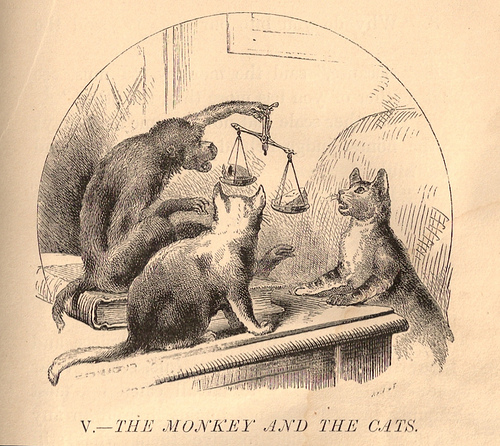
Two cats go to a monkey for justice and lose everything. Old Jataka tale. Can there be a 'honest' broker?

Fig. 6 Two cats go to a monkey for justice and lose everything. Old Jataka tale. Can there be a 'honest' broker?

The US can never ever be an honest broker anywhere, it's a Zioconned dead-end....with utter corruption and criminality....

What will be US role, if India and Pakistan were to sit down and resolve their issues. It is in US interest for instance, to create false stereotypes of Pakistanis. Let us examine some common notions about Pakistan.

Note how many multiples of Americans die each year from guns, than in Pakistan.

Yet English media selectively emphasizes the Pakistani deaths. Is the world likely to allow NATO and US, a free run of Af-Pak region, if it was declared that Pakistan suffered from tribal violence – on a scale smaller than gangsta and ghetto violence in USA.

Why does China and US renew their loyalty and friendship vows with Pakistan every week?

Nuclear nightmare, anyone?

US and its many think tanks have raised global consciousness on the dangers of Pakistani nukes falling in terrorist hands. Pakistan however sees it differently.

Pakistan’s nuclear weapons are probably quite secure from terrorists — the nukes are its crown jewels. The army cares about them in ways that it does not about bin Laden’s whereabouts or fighting the Haqqani network.

The nuclear issue looks different from Pakistan. For most of the world, the question is, can terrorists steal the nuclear weapons? In Islamabad it’s, can the United States or India steal them?

Kamran Khan, on his nightly Geo TV talk show, asked provocatively: “We had the belief that our defense was impenetrable but look what has happened. Such a massive intrusion, and it went undetected. … What is the guarantee that our strategic assets and security installations are safe?”

He was not wondering whether the nuclear weapons are safe from terrorists but from the U.S. (viaOpinion: Beware decline in Pakistani relations – Toby Dalton and George Perkovich – POLITICO.com).

The Taliban spokesman to Wall Street Journal had an even more interesting take on this issue.

The Taliban has no plans to attack Pakistan’s nuclear arsenal, its spokesman declared; The Taliban’s spokesman, Ehsanullah Ehsan, dismissed those concerns Wednesday as America’s “excuse” to pressure Pakistan’s government into fighting the Taliban, who he portrayed as the country’s true protectors.

“Pakistan is the only Muslim nuclear-power state,” Mr. Ehsan said in a telephone interview, adding that the Taliban had no intention of changing that fact. The Taliban, after all, aim to take over Pakistan and its weapons.

Mr. Ehsan’s remarks appeared tailored to appeal to that increasingly nationalist mainstream, where conspiracy theories flourish about American, Indian and Israeli plots to deprive Pakistan of its atomic arsenal. Pakistan’s nuclear capability is cherished here as the guarantor of safety from India’s far larger conventional military.

The Pakistan Taliban, an offshoot of the Afghan insurgent movement, have repeatedly tried to win public support by presenting themselves as a defender of Pakistan, though their attacks have killed thousands of Pakistanis. (via Taliban Say They Won’t Target Pakistan’s Nuclear Arsenal – WSJ.com).

How important is Islam?

The other question that bothers Indians is the anti-India, anti-Hindu, fundamentalist, radical Islamic Pakistani mindset? Whew. Did I miss anything?

Which raid-and-ravage regime would like to proclaim that their objective is raid-and-ravage? 60 years after being expelled from India, 200 years of loot on a historic scale, does Britain admit that they were here to loot and plunder India? Does Spain admit that they went to the New World to loot and enslave? All these looters needed a fig leaf to cover their raid-and-ravage operations. Religion was their cover.

Why expect Islamic raiders-and-looters to be different?

Moreover, for a raid-and-ravage party, to mislead the victim is a logical tactic. To hide a loot-agenda under a religious garb makes eminent sense for the looter. Does it make sense for us to accept their religious declaration at face value? Like we can see in the many raid-and ravage attempts.

Timurlane did not come here to convert Indians to Islam. After the raid-and-ravage attacks, Mahmud of Ghazni, Mohammed Ghori, Timur Lame, Nadir Shah did not stay behind to control their ‘conquests’. So too, in modern Pakistan. Jinnah used religion to get a Pakistan for himself – though he himself was completely irreligious. The Pakistani Army also uses religion – but is itself irreligious.

Similarly the Spanish did not go to America for Christianity – but for gold. Simple. The Spanish king told his conquistadores, ‘Get gold, humanely if possible, but at all hazards, get gold.” (1511, King Ferdinand).

The East India Company made piously declarations on how ‘the banner of Christ should wave triumphant from one end of India to the other’. But the real reason for the East India Company was raid-and-ravage.

Anuraag Sanghi on June 9, 2011
http://2ndlook.wordpress.com/2011/06/09/af-pak-the-coming-oil-bottleneck/

Like Alexander boasted of his conquest of India, many of these Islamic ‘conquerors’, also exaggerated.

Of course, Desert Bloc invented religion to create divisions, build a fifth column, in the ‘conquered’ people. Finally and initially, religion was the tool to use, many times the fig leaf too – but not the real cause for these rape-and-ravage adventures.

A 2ndlook at Pakistan

Pakistan is what Pakistan does.

Pakistan’s ability to keep its super-power allies on their toes is a remarkable diplomatic achievement. To remain a nuclear power, after near-universal condemnation and pressure reconfirms its diplomatic prowress. Pakistani leadership, from Jinnah onwards, have used the State and its institutions, for keeping a grip on power. That will continue.

What might change is the way power is shared. The Taliban may become a part of the Pakistani ruling class. How that will happen remains to be seen. A coup? Local elections, maybe. Electoral alliance? Pakistani power-equations are changing. How these equations work out, may surprise us.

Is India prepared? Ready?

Wednesday, October 05, 2011

No escape for Pakistan's Hazaras....


No escape for Pakistan's Hazaras....

By Abubakar Siddique and Khudainoor Nasar

QUETTA, Pakistan - A deadly attack in southwest Pakistan has added to the heavy toll suffered by a small Shi'ite minority amid a broad sectarian conflict.

The October 4 attack, carried out against a bus carrying mostly Hazaras on the outskirts of Quetta, claimed the lives of 12 people. There was no immediate claim of responsibility, but similar attacks against the community have previously been claimed by Sunnis affiliated with al-Qaeda and the Taliban.

Thousands have died in the ongoing conflict between rival hardline Shi'ite and Sunni sects in Pakistan, but the Hazaras have particularly suffered. The minority has been left reeling from a sharp increase in attacks in recent years, prompting some members to call on the government to provide more land to accommodate fresh graves.

Obtaining justice in the Sunni-majority state has proved elusive for some Hazaras like Rukhsana Ahmed Ali, a prominent political activist and social worker whose husband, Ahmed Ali Najafi, was killed at his workplace two years ago.

She says two eyewitnesses, young students of a religious seminary, said they heard the killers order her husband out of his car and asking them how he had wronged them.

"The killers then told him, 'You have not done anything wrong, but we have been told that killing one Shi'ite will open five doors of heaven for us,'" Ahmed Ali says. "He was then forced out of his car and killed by a whole burst of Kalashnikov fire."

'Are we humans or insects?'
Najafi's September 2009 killing marked the beginning of bloodshed against Hazaras centered in Balochistan province that has continued to this day. Hazara leaders claim that nearly 600 members of their community have been killed since 1999.

The Lashkar-e-Jhangvi, a banned extremist Sunni organization now seen as allied with al-Qaeda, has claimed responsibility for most of the attacks.

Middle-aged coal mine owner Sayed Nasir Ali Shah represents Quetta's Hazaras in the federal parliament. He was elected on the ticket of the governing Pakistan People's Party in 2008, but has since turned into one of its most outspoken critics. These days, his only mission is to try to save Hazara lives by calling for government protection.

Shah was undeterred even when he was targeted in a suicide attack last year, which left one of his young sons paralyzed. He says that protests and petitions with senior leaders have so far fallen on deaf ears.

"The government is only watching, and I am now tired after constantly shouting to grab their attention," Shah says. "I have been pleading for them to [do something to protect us] for God's sake. Are we humans or insects? We have no confrontation with our [neighboring] Balochi and Pashtun communities. We are targeted because our tormentors believe that we are infidels."

Losing battle
A century ago, Shah's Hazara ancestors fled the poverty and oppression of their Afghan homeland to the safety offered by Quetta, a British garrison town. Compared to their Afghan cousins, the Hazaras in Quetta prospered in British India and later on in Pakistan. But the tiny minority turned into a target for radical Sunnis.

Quetta once led the rest of Pakistan as an example of interfaith harmony. But Sunni extremism gradually gained traction in Balochistan's secular political culture and changed the landscape of its capital. This transformation was aided by Pakistan's alliance with radical Islamists who have fought its proxy wars in neighboring Afghanistan since the 1980s.

Abdul Khaliq Hazara, chairman of the Hazara Democratic Party, says the government had abdicated its responsibility of protecting his community. The small political party he leads hopes to provide protection to Quetta's 400,000 Hazaras by relentlessly advocating their rights.

He now sees no light at the end of the tunnel, and laments that many youths in the community are opting to seek asylum abroad.
"Nobody is listening to us - the parliament, Islamabad, the government in Balochistan, and our powerful [security] institutions," Khaliz Hazara says. "We feel that it's the government's policy to promote sectarian terrorism here. So that people keep on fighting each other because of sectarian tensions."

Balochistan, Pakistan's largest and least-populated province, is the scene of complex regional rivalries and home to many insurgent movements. The province has been destabilized by a separatist ethnic Balochi insurgency since 2004 that Islamabad is trying to crush militarily.

Insurgents' foothold?
Afghan and Western officials, however, are more concerned about the presence of Afghan insurgents in Balochistan. They blame Pakistan for sheltering the leadership of the Afghan Taliban movement in Quetta.

Police officials claim that the security environment in Balochistan is stretching their small force. Hamid Shakeel, a senior police officer in Quetta, says they always urge Hazaras traveling from Quetta to request police protection before embarking outside the provincial capital, often en route to Iran.

But there is only so much they can do, Shakeel says. "We only have 1,100 police officers for Quetta and their responsibility is not only to prevent target assassinations but they have to provide protection to senior officials," he says.

The situation prompted the Hazaras of Quetta to call for international protests this month. The Hazara Democratic Party is counting on Hazara diaspora communities to demonstrate in major cities across Europe, Australia and North America throughout October. A protest in Vienna on October 1 attracted hundreds of supporters, and the October 4 bloodshed prompted hundreds more to condemn the killings during a rally in London.

Back in Quetta, fear and uncertainty remain high. Mohammed Ismail, a Harzara trader, says that living a normal life in his once peaceful hometown is now impossible.

"When we leave our houses [in the morning] we are not sure about returning in the evening," Ismail says. "When our children go out into the bazaar, we are worried about something happening to them. These are the kind of problems we live with."