Wednesday, December 14, 2011

A massive credit crunch and A financial implosion of historic proportions are around the corner....

A massive credit crunch and A financial implosion of historic proportions are around the corner....

Sometimes banks gamble, and lose....big time, they always do....

On 12 December 2011, Global Research had an article suggesting that banks, and others, still hold a vast amount of worthless assets.

The suggestion is that many, many billions in 'ghost assets' will disappear by 2013.

(
The Derivative Debt Bubble: "Ghost Financial Assets" and the Widespread Discounting of Western Public Debt)

Think of a French bank holding Greek government bonds which are suddenly worth only half of what they were before.

And it may not just be Greek bonds.

And it is not just French banks that may suffer.....UK and US and other EU Banks too.....

According to the Global Research article:

There is the possibility of a decline of 30% in the US dollar, in the Euro and other major currencies in 2012.

The United Kingdom could be absorbed into Euroland by 2020.

Scotland may break with England.

A global and US recession could involve falling tax revenues and further drops in home values.

US private debt is far worse than in Greece.

Europe has takes steps to reduce expenditures and debts.

But the US continues increasing debt.

"We have entered a phase involving the decimation of Western banks...

"Customers of all financial operators - banks, insurance companies, investment funds, pension funds - are now questioning the soundness of these institutions.


"The Economic Collapse", on 13 December 2011, gives us
17 Signs That The European Financial System Is Heading For An Implosion Of Historic Proportions

From this we learn:

Greece has raised taxes and reduced government spending.

This has caused the Greek economy to slow down and tax revenues to decline.

100,000 businesses have closed.

A third of the population is living in poverty.

The following are signs that the European financial system is heading for an implosion of historic proportions.

1
When you reduce government spending you also slow down the economy.

2 As the economy slows down in Europe, unemployment will rise.

3 Germany, and the other wealthy nations of northern Europe, are sick and tired of bailouts and do not plan to hand over trillions of Euros.

4 The European Central Bank could print trillions of Euros, but this would go against existing treaties and most of the major politicians in Europe are strongly against this right now.

When the CIA hits the economies of such countries as Libya, Egypt, Tunisia, India, Russia, Indonesia, or China, the global economy suffers.

5 Europe is rapidly running out of time.

6 Germany has kept the focus exclusively on fiscal deficits.

This crisis was not caused by fiscal deficits (except in the case of Greece).

Spain and Ireland were in surplus, and Italy had a primary surplus.

7 There are dozens of European banks in danger of failing.

Nobody wants to 'throw any more money into those black holes'.

We could start to see banks fail in rapid succession.

Charles Wyplosz, a professor of international economics at Geneva’s Graduate Institute, says:

"Banks will collapse, including possibly a number of French banks that are very exposed to Greece, Portugal, Italy and Spain."

8 According to financial journalist Ambrose Evans-Pritchard, European banks need to reduce the amount of lending on their books by about 7 trillion dollars in order to get down to safe levels.

9 European banks are overloaded with worthless assets that have a book value of trillions of Euros.

10 Either the Germans will have to allow the ECB (European Central Bank) to print money out of thin air to buy bonds with, or, "we will finally see the market determine the true value of European government bonds."

11 Huge amounts of European sovereign debt are scheduled to be 'rolled over' next year (Money is due to be paid back to lenders; so new money must be borrowed.).

The poor cannot afford to shop anywhere on the fancy commercial streets....
12 Once the new treaty is ratified, eurozone governments will lose the power to dramatically increase government spending.

The coming recession could become a full-blown depression.

13 Credit rating agencies are warning that more credit downgrades may be coming in Europe.

14 S&P has put 15 members of the eurozone (including Germany) on review for a possible credit downgrade.

15
The stock prices of many major European banks are in the process of collapsing.

16
Bank 'runs' have been reported in certain parts of Europe.

At the start of 2010, savings and time deposits held by private households in Greece totaled €237.7 billion.

By the end of 2011, they had fallen by €49 billion.

Savings fell by a further €5.4 billion in September and by an estimated €8.5 billion in October.

17 Economic activity is slowing down.

In October, Japanese machinery orders dropped 6.9%, following an 8.2% drop in September.

South Africa has recently reported a 5.6% drop in manufacturing activity.

Britain recorded a 0.7% decline.

China’s October exports fell 1.7% after dropping 3.8% in September.

Korea’s exports are down three consecutive months. Singapore’s were off in September and October. Indonesia’s plunged 8.5% in October after slipping 2% in September. India’s dropped 18.3% after being flat in September.

"Brutal austerity + toxic levels of government debt + rising bond yields + a lack of confidence in the financial system + banks that are massively overleveraged + a massive credit crunch = A financial implosion of historic proportions."


What governments could do:

1. Nationalize or close down the zombie banks everywhere globally....

Nationalize the US Federal reserve....and the ECB. STOP Corruption at the TOP and End ALL Wars and regional conflicts peacefully NOW. Straiten the UN Body politics and Veto powers and end its utter corruption. Slash intelligence budgets everywhere since it has proven to be utterly futile, biased towards crooked policies [9/11...comes to mind] and useless....

2. Get government financial institutions to lend to business.

3. Ban the trade in 'derivatives' and other forms of gambling by banks and financial institutions.

4. Slash spending on defense and handouts to the rich.

Increase taxes on the rich and on corporations taxation's loop-holes.....

5. Increase spending on infrastructure.....


Tuesday, December 13, 2011

US the loser in Asia push...., as usual....


US the loser in Asia push...., as usual....
By Tanaka Sakai

Translation by Hase Michiko

In his remarks to the Australian parliament on November 17, President Barack Obama declared that the United States was making the Asia-Pacific region a top priority. While promising a continued US military presence in the region, Obama also expressed his intention to strengthen US-China cooperation.

This declaration, however, was made at the same time as Obama announced a series of anti-China measures: to station US forces permanently in Australia for the first time, to promote the Trans-Pacific Partnership (TPP) - a multilateral trade agreement that excludes China - and to discuss the South China Sea Islands at the Association of Southeast Asian Nations (ASEAN) summit, to Beijing's displeasure. Therefore, the Japanese media view Obama's emphasis on Asia as strengthening an anti-China containment ring.

In Japan, there is heightened expectation for Obama's new policy, which is thought to signal that the US is finally treating China as an enemy. However, the "awkward timing" of the US announcement doesn't sit well with me. Since the late-1990s, US-China relations have seen China's ascension and America's decline, especially in the economic arena. An anti-China policy of the United States would inevitably involve pro-US Asian countries like Japan, South Korea, and ASEAN.

Those Asian nations, however, cannot afford to antagonize China because it has replaced the US as their biggest trading partner. The same is true for the United States: it cannot go too far in antagonizing China, the largest holder of US treasury bonds, because if China sold them, US finance and the dollar would collapse.

If the US intended to treat China as an enemy and fortify its anti-China containment as a national strategy, it should have started sooner. From the perspective of the interests of both the Asian nations and the United States, it is absurd for the US to adopt an anti-China policy in Asia at a time when China has become the most important country in the economic arena.

Give Asia priority - abandon UK and Israel
If one puts the issue in a global, rather than Asian, perspective, one begins to see another meaning of the US declaration to give Asia top priority. The flip side of an emphasis on Asia is putting less emphasis on the Middle East and Europe, the regions that previously received top US priority.

In the Middle East, Israel has dictated US world strategies since the1970s, but Israel now needs US support more than ever. Until the invasion of Iraq in 2003, US domination in the Middle East had served Israel well. After the 9.11 attacks in 2001, US world strategy so focused on the Middle East that some said it had become a Middle-Eastern country, while US allies in Asia, including Japan, were close to being ignored.

Since then, however, there has been a backlash against the extreme anti-Islam policy of the United States in the form of an anti-US , anti-Israel Islamist movement; since the revolution in Egypt last spring, Islamism has been accelerating under the rubric of democratization. Previously pro-Israel Egypt and Turkey have since turned anti-Israel, and the Palestinian Authority, once a puppet of the US and Israel, is increasingly defiant in its attempt to gain United Nations membership. Even in formerly secular Tunisia and Morocco, the Islamists are rising in the elections.

The United States has not changed its pro-Israel policy. US politics is still under the thumb of right-wing Israelis. However, the US followed the wishes of the Israeli right-ring in carrying out "democratization" as a way to overturn the government, and as a result anti-American, anti-Israel Islamism has risen.

For this reason, it has now become impossible for Israel to press the US to change the current situation in ways more favorable to Israel. Besides, US military forces are scheduled to pull out of Iraq by the end of the year. US military influence in the Middle East will decrease dramatically.

At the very time that all this was happening, the Obama administration launched its policy of giving Asia top priority. The US government will maintain the appearance of being at Israel's beck and call, but in practice it is about to abandon Israel surrounded by its enemies. The Muslim Brotherhood is overjoyed. From a Middle-Eastern perspective, Obama's emphasis on Asia means the "abandonment of Israel".

US global policy-making has also been dictated not only by Israel but by the United Kingdom. To the UK, the 40-year-long Cold War was a long-term strategy to fortify its alliance with the US with the objective of confronting the Soviet Union. After the Cold War, the US-UK alliance controlled the world through financial markets. Today, however, as the US-UK financial system continues to break down, Obama's emphasis on Asia means a shift to prioritizing Asia over the US-UK alliance, and this is not good news for the UK.

The European Union is in the midst of a euro crisis. American and British speculators are trying to crush the euro, their potential rival, to protect the US dollar as the key international currency. Financial integration of the euro zone, which would strengthen the EU, is needed to stave off the ongoing crises.

The EU, centering on Germany, has been battered by the US and UK in this crisis. Therefore, after the current crisis the EU will reduce its dependency on the US and strengthen its collaboration with countries like Russia, which are anti-US and geopolitically important to the EU. Just as Europe was going through this transition, Obama unleashed his "Asia First" announcement, which is virtually a declaration of a "Europe Second" policy.

The United States was traditionally an "Atlantic country". This time, the US has announced that "we are a Pacific country". To Europe, this means that the US will not emphasize Europe as before. American speculators caused the bond crisis, hurting the EU; the EU in turn is likely to think: "If the US is not going to emphasize Europe, we won't emphasize the US , either."

The North Atlantic Treaty Organization, the Europe-US military alliance, will lose its importance, too. The end of the NATO mission in Afghanistan in 2014 will likely be a turning point.

US -China strategy not transformed
Let's turn to Asia again. The most important question left unanswered in Obama's Asia-first announcement is "whether the US is going to treat China as an enemy in earnest." "Does the US consider China an enemy or a future ally?"

The question itself and the ambiguity surrounding it existed 100 years ago, when the United States supported Sun Yat-sen's Nationalist Revolution. The United States considered China a prospective ally until the Korean War in 1950 (which is why the US made China a permanent member of the United Nations Security Council after World War II even though it was then a divided and weak country).

Between the Korean War and president Richard Nixon's visit to China in 1972, the United States was dominated by the Cold-War camp (the military-industrial-British complex) and tended to view China as an enemy. Nixon's China visit transformed the situation, and the United States has since had the mixed policy of viewing China both as an enemy and as a prospective ally.

In US politics under the powerful influence of the military-industrial complex supported by the UK and Israel, previous US administrations deliberately left ambiguous the question of whether China was an enemy or an ally. Although the ambiguity lingers, since the 1990s when it lifted the economic sanctions that it had imposed after the Tiananmen Square incident, the US has gradually been treating China more as a prospective ally in the situation in which it began to develop as an economic superpower.

The strongest recent expression of the US embrace of China as a prospective ally was the proposal for a "US -China G2", recognizing China as "a responsible superpower (-to-be, along with the US ) during the former George W Bush administration.

If Obama's "Asia First" declaration was a clear indication of "China as an enemy", that would be a reversal of the China strategy that the US had maintained until the end of the Bush administration. But it is unclear whether Obama's Asia-first policy is a policy to treat China as an enemy. This vagueness is a continuation of the deliberate ambiguity in the US strategy toward China since Nixon's visit to China. The conclusion drawn from the foregoing analysis is that Obama has not reversed the previous course of US strategy toward China.

The interests of the military-industrial complex, which pushed the US to treat China as an enemy, have been paralyzed by the failure of the wars on terror. Large US companies, including financial interests, are making profits in China and would not want to be driven out of the Chinese market as a result of worsening US-China relations. I do not think that there are many at the center of power in the US who wish to promote "an anti-China policy that goes beyond campaign rhetoric".

Recently, even the military-industrial complex has refrained from promoting an overt anti-China agenda. The Department of Defense is said to be working on a military strategy called "Air-Sea Battle" to contain China. At a recent Pentagon press conference, however, the discussion remained opaque, only revealing that "it is a not a strategy, not a concept of operations, ... and is not directed at any particular country". [1]
One explanation that is circulating is that the Air-Sea Battle concept involves a shift from the old way of attacking an enemy (China) by launching planes from huge aircraft carriers to one of launching unmanned fighters and short-range missiles from smaller warships. But the Pentagon has not clarified the strategy.
The Bush administration, too, tended to keep the goals of "transformation" secret, but the main goals were to upgrade US military technology, to make the military smaller and lighter, and to ensure profits for the military-industrial complex by pouring in huge development funds. The true aim of Air-Sea Battle, too, may be to increase profits for the military-industrial complex while suggesting that it is a strategy to counter China's growing military power.

The Obama administration made its "Asia First" announcement simultaneously with announcing plans for the TPP and the US-Korea Free Trade Agreement. The timing suggests a bargain: "Accommodating the wishes of Asian nations like Japan, South Korea and Australia nervous about China's rise, the US will not withdraw its forces from the Asia-Pacific. In exchange, Asian countries, through TPP and FTA, must restructure their economic systems to assure US corporate profits". [2]

Trampling with free trade agreements
In Australia, Obama emphasized that "reductions in US defense spending will not - I repeat, will not - come at the expense of the Asia Pacific". This gives the impression that the US government is increasing its military expenditures in the Asia-Pacific despite overall budget reductions.

However, there is a 20-year-old pattern in which every time the Japanese government has sought continued US military presence, the US has made it contingent on Japan's increased share of expenditures for US bases in Japan, resulting in a greater financial burden on Japan. If this pattern holds, the Australian government will shoulder part of the cost of building new Marine barracks and other expenditures for having US Marines stationed in Australia.

If some of the US Marines in Okinawa are to be moved to Australia, and if the Australian government is to pay for the transfer, the US only dictates the terms of the exchange. Neither the US nor the Australian government has disclosed anything about cost. But given the dire state of US finances, it is highly possible that Obama announced that "America will give Asia a top priority (as long as Asia bears the cost)." It is reasonable to think that TPP and US military presence come with an expensive price tag.

The US government has announced that it will shape TPP into a free-trade agreement among countries that abide by a rules-based order. The US thinks that China's lack of a rules-based order - it's a party dictatorship - makes it ineligible to join TPP. However, Vietnam, with a one-party rule similar to China's, has been allowed to participate in the negotiations. This suggests that the US treats TPP as part of the anti-China containment ring that excludes China politically.

If TPP is a US -led containment ring directed against China, the question remains whether it is effective. My conclusion is that TPP will not be effective in containing China. To many Asian countries, China is the biggest trading partner, and China's importance will only increase in the future. By contrast, the United States, which was long the greatest trading partner of most Asian nations, has lost its middle classes' spending power and will lose its status as a dominant trading partner.

Given the precedent set by the US-Korea FTA, moreover, participation in TPP would compel Japan to change its economic rules modeled on American ones. The United States in the past few years has been rife with corrupting tendencies, allowing large corporations to change government rules to their liking through lobbying activities. Japan, as a TPP member nation, would be put under constant pressure to reshape its domestic economic institutions to benefit US businesses. The "rules" in the US government's "rules-based order" are those that are prevalent in the US and favor large US businesses.

China and Russia may take over WTO
Asian nations nervous about China's rise are begging the US not to leave Asia. The US government is telling them: "We are not leaving Asia, but you must pay for our base expenditures. In addition, join TPP or the US-Korea FTA and make your domestic systems profitable for US companies."

The United States is not to blame. The dependency of Asian nations like Japan is allowing the US to pursue a crafty strategy.

The more the US publicizes its anti-China containment, the more quickly China will strengthen its military to counter it. The more China strengthens its military, the more fearful Asian countries will become, increasing their dependency on the US , and the United States will take advantage of the dependency to impose a corrupt American-style economic system on Asia.

The corruption of their economic systems will in turn weaken Asian nations, including Japan. China, which is excluded from TPP, will be spared this baptism of corruption. China alone will profit from TPP.


On top of this, the United States will be an unreliable importer of Asian goods while Asian countries will continue to increase their economic dependence on China. The current US strategy toward Asia only reinforces China's superiority. By the time Asian nations give up on a weakened America, their economic systems will be in tatters as a result of TPP, and there will be no choice for them but subservience to an even more powerful China.

The US Asia policy looks to be a "disguised multipolarism (polycentrism)" which actually "strengthens China while pretending to contain it" and "pushes Asian nations toward China while professing to ally with them."

In terms of the international trade system, Russia's accession to the WTO, which is likely to occur by the end of this year, will benefit China. China and Russia are fortifying their strategic ties. Once Russia is admitted to the WTO, China, already a WTO member, will work together with Russia to recruit the other BRIC countries - India and Brazil - and developing countries like South Africa, to transform the WTO politically from a system favoring advanced economies into one favorable to emerging and developing countries. [3]

The Doha round of the WTO has stalled for the past several years. It is possible, however, that by the time the WTO gets moving again, it may have been taken over by emerging countries and may try to dominate the world as a completely transformed body.

Some people may think that China would not want to maintain a free-trade system, but they are wrong. While weak economies tend to lose under a free-trade system, it benefits stronger economies. The economic strengths of BRIC are approaching the level at which it suits their national interests to promote a free-trade system.

Tanaka Sakai is the creator, researcher, writer and editor of Tanaka News (www.tanakanews.com), a Japanese-language news service on Japan and the world. The title of Tanaka Sakai's new book is translated as
The Day Japan Breaks with 'Subordination to the US': Amidst the Multipolarizing New World Order.

Hase Michiko taught women's studies at San Jose State University and the University of Colorado at Boulder. She participates in Women for Genuine Security and has served as a translator and interpreter at international meetings.

Notes
1.
Air-Sea Battle: What's It All About, Or Not , AOLDefense, November 10, 2011.
2. See
here.
3. See
Russia clears final hurdle for WTO membership, November 10, 2011.

Monday, December 12, 2011

Its back to the future for the ZIOCONNED and utterly corrupt/Criminal CIA, Langley's involvement the White House Murder INC


Its back to the future for the ZIOCONNED and utterly corrupt/Criminal CIA, Langley's involvement the White House Murder INC, and in smuggling drugs into the United States and many other countries .....


December , 2011 -- Giffords, Roll Hit a Planned Twin Assassination...


A knowledgeable federal government counter-narcotics source in Arizona has revealed to us that the shooting on January 8 this year of U.S. Representative Gabrielle Giffords and U.S. Judge John Roll in Tucson was planned as a twin assassination of two individuals who threatened to expose a weapons-for-drugs smuggling operation carried out by a covert group working under the aegis of the Central Intelligence Agency and Homeland Security Secretary Janet Napolitano. In fact, the covert operation dates back to when Napolitano was governor of Arizona. Roll had been Chief Judge of the District of Arizona since 2006. The assassin, Jared Lee Loughner, killed five others and wounded thirteen, including Giffords, at a Safeway parking lot in north Tucson. Loughner's first and priority targets were Roll and Giffords.

We have also been told that while the U.S.-Mexican border operation oversees the smuggling to Mexican drug cartels of weapons, including fully automatic AK-47s, in return for drugs smuggled across the border, mostly delivered by airplanes that make clandestine drops on pre-approved drop zones or landing strips in Arizona, New Mexico, and west Texas, at night, it is only peripherally connected to the "Fast and Furious" operation.... Our source said that there were so many weapons being smuggled across the border that some were dropped, including a new AK-47 that was found in a wash on the Arizona side of the border. When the discoverer of the weapon contacted federal authorities about his find, he was told to keep the weapon since there were so many in the area. The "area" in question is said to be a special zone created by Napolitano when she was governor and that the special operations carried out there involve a number of "former" CIA, Navy SEALS, and other Special Operations thugs/personnel.....

Operation Fast and Furious was a weapons tracking program conducted by the Justice Department's Bureau of Alcohol, Tobacco, Firearms and Explosives....LOL In what is known as "gun walking," agents permitted the sale to Mexican cartels of weapons obtained from Phoenix area gun stores in order to identify the major weapons traffickers on the U.S. and Mexican side of the border. However, Fast and Furious soon allowed for some 2,000 weapons purchased in the United States to end up in the hands of drug cartels. Two of the weapons were later used to kill U.S. Border Patrol agent Brian Terry on the U.S. side of the border.

House Republicans are calling for Attorney General Eric Holder to fire all those involved with Fast and Furious, something he has refused to do in a wholesale manner. Holder claims Fast and Furious was a "regional" operation and that little direction came from Washington. Holder, we are told, is not being forthcoming because of the possibility that the more secretive weapons-for-narcotics operation being conducted by the CIA and Napolitano could be exposed. In fact, Napolitano's predecessor as Homeland Security Secretary, Michael Chertoff, who still advises his old department, has defended the head of the Justice Department's Criminal Division, Lanny Breuer, over charges that Breuer has covered up Fast and Furious details.

We have been told that in 2009, information about the CIA/Homeland Security/Napolitano smuggling operation came to the attention of three individuals, two members of Congress and a federal judge. The three were Arizona Democratic Representatives Giffords, Republican Representative Mike Conaway from west Texas, and Judge Roll. Giffords and Roll were working together on investigating the extent of the clandestine weapons and drugs smuggling operation and held some joint meetings with informants, one in north Phoenix, in 2009. Information on the investigation and informants was strictly limited to only a few trusted staffers and clerks for Giffords and Roll. In addition, Conaway was also being briefed by informants on the smuggling operation but since the death of Roll and the severe mental and physical incapacitation of Giffords from the shooting carried out by Jared Lee Loughner, said to be an MK-ULTRA-like trained assassin, he has gone silent in fear for his own safety. Loughner's was declared mentally incompetent and there are reports, including one in Slate Magazine, that the U.S. Medical Center for Federal Prisoners in Springfield, Missouri, where Loughner is being held, pending a determination of his mental fitness to stand trial, is being administered psychotropic drugs in Kool Aid.


In addition to receiving drugs to fund its off-the-books operations, the CIA weapons smuggling program is designed to arm the two main Mexican cartels -- Sinaloa and Los Zetas -- in order to destabilize Mexico. A violence-ridden Mexico makes it more dependent on U.S. military aid and, eventually, the country is seen by Washington as a future virtual U.S. protectorate, whose state PEMEX-controlled oil reserves will be available to CRIMINAL U.S. oil companies, like the crooked war criminal and controller of the barbaric inside Job of 9/11 and the HEAD assassin of the infamous White House Murder INC, in the Levant since January 24th 2002.....


Sunday, December 11, 2011

The financial crisis was entirely foreseeable....


The financial crisis was entirely foreseeable....

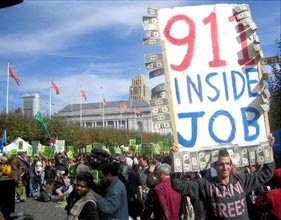
Everything Happening Now Was Planned Before the Barbaric Inside Job of 9/11....

Special preface to my friends in the military, law enforcement and intelligence and other government servants: You are sworn to defend and uphold the Constitution wherever you are...., and the facts below may help you do so.....

We’ve been told that “9/11 changed everything” and that we’re living in “a post-911 world”.

We’ve been told that what our government is doing now has been rendered necessary by the urgent post-9/11 threat from terrorists.

In reality, however, virtually everything happening now was planned before 9/11. Please see for yourself:

  • The Patriot Act was planned before 9/11 (and see this). Indeed, former Counter Terrorism Czar Richard Clarke told Stanford law professor Lawrence Lessig:

After 9/11 the government drew up the Patriot Act within 20 days and it was passed.

The Patriot Act is huge and I remember someone asking a Justice Department official how did they write such a large statute so quickly, and of course the answer was that it has been sitting in the drawers of the Justice Department for the last 20 years waiting for the event where they would pull it out.

(4:30 into this video).

  • Government plans, exercises or drills to detain American citizens who opposed war were also drawn up before 9/11, as was a bill allowing the permanent detention by the Attorney General of aliens convicted of no crimes, with no judicial review
  • The Afghanistan war was planned before 9/11 (see this and this)
  • Cheney made Iraqi’s oil fields a national security priority before 9/11. And the Sunday Herald reported: “Five months before September 11, the US advocated using force against Iraq … to secure control of its oil.” (remember that Alan Greenspan, John McCain, George W. Bush, Sarah Palin, a high-level National Security Council officer and others all say that the Iraq war was really about oil.)
  • Wars throughout the Middle East and North Africa to effect regime were planned before 9/11
  • America played dirty games to justify wars before 9/11.....

The Core of the Patriot Act Was Drafted in 1995 … By the Skunk Joe Biden....

Everyone knows that the Patriot Act was drafted before 9/11.

But few know that it was Joe Biden who drafted the core provisions which were included in that bill … in 1995.

CNET reported in 2008:

Months before the Oklahoma City bombing took place, Biden introduced another bill called the Omnibus Counterterrorism Act of 1995. It previewed the 2001 Patriot Act by allowing secret evidence to be used in prosecutions, expanding the Foreign Intelligence Surveillance Act and wiretap laws, creating a new federal crime of “terrorism” that could be invoked based on political beliefs, permitting the U.S. military to be used in civilian law enforcement, and allowing permanent detention of non-U.S. citizens without judicial review.* The Center for National Security Studies said the bill would erode “constitutional and statutory due process protections” and would “authorize the Justice Department to pick and choose crimes to investigate and prosecute based on political beliefs and assocblank Joe Biden Drafted the Core of the Patriot Act in 1995 ... Before the Oklahoma City Bombingiations.”

Biden himself draws parallels between his 1995 bill and its 2001 cousin. “I drafted a terrorism bill after the Oklahoma City bombing. And the bill John Ashcroft sent up was my bill,” he said when the Patriot Act was being debated, according to the New Republic, which described him as “the Democratic Party’s de facto spokesman on the war against terrorism.”

***

Biden’s proposal probably helped to lay the groundwork for the Bush administration’s Patriot Act.

The Center for National Securities reported in 1995:

On February 10, 1995, a counterterrorism bill drafted by the Clinton
Administration was introduced in the Senate as S. 390 and in the House of
Representatives as H.R. 896.

The Clinton bill is a mixture of: provisions eroding constitutional and
statutory due process protections, selective federalization — on political
grounds — of state crimes (minus state due process rules), discredited
ideas from the Reagan and Bush Administrations, and the extension of some of
the worst elements of crime bills of the recent past.

The legislation would:

1. authorize the Justice Department to pick and choose crimes to
investigate and prosecute based on political beliefs and associations;

2. repeal the ancient provision barring the U.S. military from civilian
law enforcement;

3. expand a pre-trial detention scheme that puts the burden of proof on
the accused;

4. loosen the carefully-crafted rules governing federal wiretaps, in
violation of the Fourth Amendment;

5. establish special courts that would use secret evidence to order the
deportation of persons convicted of no crimes, in violation of basic
principles of due process;

6. permit permanent detention by the Attorney General of aliens convicted
of no crimes, with no judicial review;

7. give the President unreviewable power to criminalize fund-raising for
lawful activities associated with unpopular causes;

8. renege on the Administration’s approval in the last Congress of a
provision to insure that the FBI would not investigate based on First
Amendment activities; and

9. resurrect the discredited ideological visa denial provisions of the
McCarran Walter Act to bar foreign speakers.

* Note: The CNET article contains a typographical error, using the word “detection” instead of “detention” in the sentence: “allowing permanent detection of non-U.S. citizens without judicial review”. Not only does this make no sense, but a review of the bill confirms that it provided for permanent detention.....

The financial crisis was entirely foreseeable....

Foreseeable or Not?

April:

Whenever there is a disaster, those responsible claim it was “unforeseeable” so as to escape blame.

For example:

  • It happened with 9/11
  • It happened with the BP oil spill (see this, this, and this)
  • It happened with the Japanese nuclear accident

The big boys gamble with our lives and our livelihoods, because they make a killing by taking huge risks and cutting costs. And when things inevitably go South, they aren’t held responsible (other than a slap on the wrist), and may even be bailed out by the government.

But surely the financial crisis was different. After all, Wall Street executives and politicians say that the financial crisis wasn’t foreseeable. .

Actually, it might have been slightly foreseeable for a little while before the financial crisis.

We’ve Known for Thousands of Years

We’ve known for literally thousands of years that debts need to be periodically written down, or the entire economy will collapse. .

We’ve known for 1,900 years that that rampant inequality destroys societies.

We’ve known for thousands of years that debasing currencies leads to economic collapse.

We’ve known for hundreds of years that the failure to punish financial fraud destroys economies.

We’ve known for hundreds of years that monopolies and the political influence which accompanies too much power in too few hands is dangerous for free markets.

We’ve known for hundreds of years that trust is vital for a healthy economy.

We’ve known since the 1930s Great Depression that separating depository banking from speculative investment banking is key to economic stability. See this, this, this and this.

We’ve known since 1988 that quantitative easing doesn’t work to rescue an ailing economy.

We’ve known since 1993 that derivatives such as credit default swaps – if not reined in – could take down the economy. And see this.

We’ve known since 1998 that crony capitalism destroys even the strongest economies, and that economies that are capitalist in name only need major reforms to create accountability and competitive markets.

We’ve known since 2007 or earlier that lax oversight of hedge funds could blow up the economy.

And we knew before the 2008 financial crash and subsequent bailouts that:

  • The easy credit policy of the Fed and other central banks, the failure to regulate the shadow banking system, and “the use of gimmicks and palliatives” by central banks hurt the economy
  • Anything other than (1) letting asset prices fall to their true market value, (2) increasing savings rates, and (3) forcing companies to write off bad debts “will only make things worse”
  • Bailouts of big banks harm the economy
  • The Fed and other central banks were simply transferring risk from private banks to governments, which could lead to a sovereign debt crisis

Given the insane levels of debt, rampant inequality, currency debasement, failure to punish financial fraud, growth of the too big to fails, repeal of Glass-Steagall, refusal to rein in derivatives, crony capitalism and other shenanigans … the financial crisis was entirely foreseeable....


Friday, December 09, 2011

China tunnel and nuclear warhead follies....


China tunnel and nuclear warhead follies....
By Peter Lee

The recent hubbub over the size of China's nuclear warhead stockpile and its underground maze of missile hidey-holes, the notorious "Underground Great Wall of China" is, on one level, a battle between sensationalizing amateurs and incensed arms control professionals.

On another level, it highlights a continuing nuclear security stand-off between the United States and China.

The furor was kicked off by a November 29 article by the Washington Post's William Wan. It described a study of China's strategic nuclear missile program prepared by a team of students working under Phillip Karber, an adjunct professor at Georgetown University, in an arms control seminar. Wan's breathless opening set the tone:
The Chinese have called it their "Underground Great Wall" - a vast network of tunnels designed to hide their country's increasingly sophisticated missile and nuclear arsenal.

For the past three years, a small band of obsessively dedicated students at Georgetown has called it something else: homework.

Led by their hard-charging professor, a former top Pentagon official, they have translated hundreds of documents, combed through satellite imagery, obtained restricted Chinese military documents and waded through hundreds of gigabytes of online data.

The result of their effort? The largest body of public knowledge about thousands of miles of tunnels dug by the Second Artillery Corps, a secretive branch of the Chinese military in charge of protecting and deploying its ballistic missiles and nuclear warheads.

The study is yet to be released, but already it has sparked a congressional hearing and been circulated among top officials in the Pentagon, including the Air Force vice chief of staff.

Most of the attention has focused on the 363-page study's provocative conclusion - that China's nuclear arsenal could be many times larger than the well-established estimates of arms-control experts. [1]
The coverage also provided an incendiary estimate:
Based on the number of tunnels the Second Artillery is digging and its increasing deployment of missiles, [Karber] argues, China's nuclear warheads could number as many as 3,000.
The story as Wan presented it contained several irresistible elements, to whit: 1) A team of renegade students displays 2) ingenuity and elbow grease to 3) expose the errors of pointy-headed so-called experts while 4) revealing Chinese perfidy and 5) alerting the people of America to terrible threat.

This wonderful story had just two flaws: the parts of it that were true weren't new, and the parts that were new appear not be true.

The true part of the story concerned that immense network of Fu Manchu-like caverns, the "Underground Great Wall of China". Ever since Douglas MacArthur threatened the People's Republic of China (PRC) with strategic nuclear bombing during the Korean War in the early 1950s, the Chinese communists have been industrious tunnelers, as tourists who have enjoyed Beijing's Underground City - and the 500-meter airfield residing inside a hollowed-out mountain at the Air Force Aviation Museum at Xiaotangshan outside the capital - can attest.

The existence of the strategic missile tunnels is also rather widely known, although it seems to have escaped William Wan in his research for his article. Wan incautiously wrote:
While the tunnels' existence was something of an open secret among the handful of experts studying China's nuclear arms, almost no papers or public reports on the structures existed.
Unless one considers the tens of millions of readers of Xinhua and Global Times or the millions who watch Rupert Murdoch's Phoenix Channel "a handful of experts", Wan's statement is, regrettably, false.

In 2009, China's Second Artillery Corps opened their underground facilities to journalists in order to publicize the investments the People's Liberation Army (PLA) has made in improving the survivability of its nuclear arsenal and, thereby, maintaining the credibility of the PRC's deterrent.

A Phoenix TV segment aired footage of tunnel construction and interviews with PLA talking heads who proudly revealed that construction was now a matter of mechanization and automation, not manual labor, banishing the Mao Zedong-era paradigm of blue ants grubbing away at the naked rock with their bare hands. Indeed, the new tunnels, with their automated blast doors and tiled surfaces, evoke modern construction marvels like the Channel Tunnel. [2]

In December 2009, Xinhua ran a Global Times piece that careful invoked extensive foreign reporting to reveal a massive project to harden China's nuclear sites.

The story reported that, with the advent of more accurate missiles and more powerful spy satellites by China's potential antagonists, the previous strategy of hardening surface sites and mixing them with decoy sites was no longer effective. Therefore, the government embarked on a massive, 10-year program to put its entire nuclear deterrent deep underground, several hundred meters below the surface.

The program was first revealed on national television in 2006, apparently as a riposte to claims by US analysts that China did not have a credible "second strike" capability; ie the ability to launch a nuclear counterattack after absorbing someone else's nuclear incoming.

With its usual subtlety, Global Times put the key money quote - the opinion of a "Western expert" - in boldface:
If nuclear bunker-busting missiles were employed against China's missile bases, it would take a strike of several tens of missiles with yields of tens of megatons each striking at the same point to penetrate; and it would take several more missiles to destroy the facility completely.
The article let it be known that the project might extend as far as 5,000 kilometers (just short of 3,000 miles) and that it had been dubbed "the Underground Great Wall". The source: "foreign analysts". [3]

That was the state of play in 2009: the tunnels were built, nicknamed, displayed on television, and their length and other characteristics discussed in the media; interested foreign spooks, analysts, and national security types were well aware of the situation.

It is unclear what additional insight Karber's hardworking team at Georgetown (which reportedly suffered from a dearth of Chinese-speaking members) actually added to specialists' understanding of the tunnel project.

But it was the "3,000 warheads" claim, illustrated with what might go down in arms control history as "The Karber Curve", that roused arms control analysts to their greatest anger.

When asked by Asia Times Online if he had a comment on the issue, Dr Jeffrey Lewis, an arms control authority and author of Minimum Means of Reprisal: China's Search for Security in the Nuclear Age, responded:
Oh yes, the claim that China has 3,000 nuclear weapons is utter bullshit.
China's holdings of weapons-grade nuclear material have been the subject of intense interest and study. Open source and classified government studies apparently agree that China has enough metal for about 400 warheads.

The best informed estimate in the public domain is laid out by Hui Zhang, who lists the range of estimates in a recent paper for the Belfer Institute at Harvard, concluding with his own figure for Chinese military plutonium stocks: 1.8 tons plus/minus 0.5 tons. The high end of the highest estimate is 4.35 plus/minus 2.2.5 tons 6.6 tons. A highly efficient warhead design would require at least 5 kg of material. Per Zhang's midline estimate, that would yield 360 warheads; the highest range of the highest estimate would yield 1,300 warheads. [4]

That is still a long way from Karber's 3,000.

The relatively stingy estimates of China's warhead stockpile is based on the assumption that China's only two plutonium breeder reactors have been shut down since the 1980s.

If Karber's team had discovered a new source of plutonium - or new evidence that China's warhead stockpile had grown significantly beyond the estimates - it would indeed have been a major find, and the arms control community would have had considerable egg on its face.

However, it appears that Karber extrapolated his 2011 numbers from a 1995 estimate in a gossipy Hong Kong political magazine, Trend, which claimed that China had a stockpile of 2,350 warheads.

After becoming aware of Karber's as yet unpublicized claims in September, China arms control specialist Gregory Kulacki investigated the situation in Hong Kong and drew the conclusion that Trend's number - which has circulated on the Internet for years - perhaps itself grew out of 1986 estimates by a US naval officer in a Western defense publication, not China's defense establishment. [5]

The Trend magazine magazine estimate, by a pseudonymous author, filled with enticing detail and the tantalizing statement, "According to information revealed by China's Ministry of Defense on July 15 of this year, as of June 30, 1995, the Chinese Communist nuclear weapon stockpile held 2,350 warheads," remains unsourced and unconfirmed, leading a lonely existence as an extreme outlier in estimates of Chinese warhead stockpiles. [6]

The Georgetown group was not even the first to unearth the Trend estimate; for that matter, it did not even locate the original article. Karber's team leaned on a short essay by a Singapore University graduate student, Yang Zheng, citing the figure, and spin-off references on the Chinese Internet.

Yang's piece had already been ferociously debunked by Jeffrey Lewis in 2004 and 2009. Lewis ultimately determined that Yang also had not accessed the Trend article himself; he had simply availed himself of a summary of the article posted on a Usenet bulletin board by a curious mathematics professor.

This exhaustive sleuthing was missed or ignored by Karber, to Lewis' considerable resentment, compounded by the fact that the Washington Post declined to publish his letter, which Lewis subsequently posted on his blog. It read, in part:
So where does Dr Karber get his wildly divergent estimates? Nowhere does Mr Wan mention that Dr Karber's "analysis" of China's plutonium production relies on a few Chinese blog posts that discuss a single, anonymous 1995 Usenet post, subsequently plagiarized by a Singapore University student, that is so wildly incompetent as to invite laughter. (I have mocked this essay repeatedly on my own blog, Arms Control Wonk.com.) Actually, Dr Karber doesn't mention this either. His research ended with the Chinese blog posts, which is something that no responsible scholar would do. …
If I take any solace out of this pathetic episode, it is that Dr Karber's students will have learned first-hand how not to do research. [7]
Karber's defense, as summarized in his appearance on al-Jazeera and an interview with the New York Daily News apparently boils down to his conviction that 3,000 miles is just "too much tunnel" for China's stated warhead inventory:
"It doesn't make any sense to build ten miles of tunnels to hide one nuclear weapon," Karber told the Daily News. [8]
Despite its shaky evidentiary and analytic underpinnings, news of the Georgetown study flew around the world, creating the damning image of a massive, secret, sneaky Chinese nuclear surge. Seattle Times: US students dig up China's nuclear secrets: Arsenal could be huge [9]

Al-Jazeera: China's nuclear arsenal 'many times larger' [10]


Daily Mail: China 'has up to 3,000 nuclear weapons hidden in tunnels', three-year study of secret documents reveals [11]

Digital Journal: U.S. study claims massive underground Chinese nuclear stockpile [12]
If the Karber furor was merely a matter of an ambitious national security entrepreneur throwing out an irresponsible estimate in order to generate some career heat for himself; or a case of the media happily seizing on an irresistible China-bashing story without letting facts or serious reporting get in the way; or the old, familiar spectacle of the national security establishment hyping a new threat in order to pad and protect its budget, then perhaps the arms control fraternity would have let the matter go with a cynical shrug.

Instead, arms control professionals have engaged in serious, aggressive pushback. The Wall Street Journal, Agence France-Presse, and, to be fair, the Washington Post's William Wan all reported on the vehement skepticism of specialists in the field.

It appears to have had some effect.

On December 6, Kulacki noted on his blog:
Tomorrow (Dec 7), Prof Karber will apparently present a different graph on the size of China's nuclear arsenal in his talk at the Elliot School of International Affairs. [13] Karber has apparently abandoned the 3,000-warhead extrapolation, and substituted a graphic illustrating the annual rate of warhead production, without giving totals.

However, the claims of production rates apparently rely on the same questionable, bloggy data used to generate the notorious curve.

Kulacki, who appears to have made a journey to Hong Kong expressly to research and debunk Karber's claims, revealed that there are significant policy issues at stake concerning the Barack Obama administration's nuclear negotiation posture with the PRC:
Chinese declaratory policy ... states ... that China's nuclear weapons are to be used only in retaliation after China suffers a nuclear attack.

US participants in the dialogues are trying to force their Chinese counterparts to stop talking about China's no first use assurance, and to stop pressing the United States to offer a similar assurance to China. The US military and diplomatic establishment does not find such an assurance credible, or believe it contributes to stability. But the Chinese disagree. As a result, the talks have been deadlocked for over a decade, leaving the public discussion open for the wild and unfounded speculations of people like Karber. [14]
It looks like the fundamental problem is this: China wants its expeditionary force to cross the Taiwan Strait free of the threat of a US tactical nuclear first strike that negates China's advantages in conventional manpower and materiel. In order to stay America's hand, the PLA has a doctrine of no first use and strategic retaliation. If the United States accepted a no-first-use doctrine, then Chinese military planning would be considerably simplified.

The US military, on the other hand, wants the option of incinerating the PLA's expeditionary force with tactical nuclear weapons, absent the distraction of realizing that defense of Taiwanese freedom may involve the destruction of [insert your favorite US city here]. If only the Chinese would acknowledge it shares a doctrine of first use, then arms control negotiations could be targeted toward reducing the size of arsenals and taking strategic nuclear strikes off the table (while presumably leaving tactical ones on the table).

Nothing doing, as far as the Chinese are concerned. The Chinese leadership apparently likes its plain vanilla retaliatory doctrine just the way it is.

Apparently, for the US security establishment's response to this conundrum is a policy of "I reject your reality and substitute my own."

Writing in Arms Control Today, Kulacki asserted that the Obama administration is forum-shopping, trying to locate first-strike enthusiasts inside the Second Artillery Corps:
The US participants in these talks do not appear to respect anyone, from either country, who takes a no-first-use pledge seriously. To them, the pledge is an expression of na๏vet้ or mendacity. They suspect, therefore, that the Chinese individuals participating in bilateral talks either cannot or will not speak truthfully about China's "actual" nuclear weapons policy. ...
The US response to this impasse is to search for a different set of Chinese interlocutors. US security analysts and military planners scour Chinese military literature to look for kindred Chinese authors who view China's commitment to a no-first-use policy as they do. Some US analysts believe they located strong candidates in authors from the Second Artillery, the branch of the Chinese military that operates China's land-based nuclear missile forces. Obama administration officials responsible for the US-Chinese nuclear dialogue are pressing to talk directly with the leadership of the Second Artillery in the belief that they will speak with a different and more authoritative voice than the officials sent previously by the Chinese government. [15]
Kulacki contrasts the US-China impasse with the US-Russia situation, where both sides are sitting on massive weapons stockpiles they wish to reduce:
Russian and US arms control experts are birds of a feather who can talk for hours and with great enthusiasm about nuclear arms control. The recent negotiations over the New Strategic Arms Reduction Treaty showed that although it still is very difficult for them to reach a binding agreement, discussions, at least, proceed with a high degree of mutual appreciation and respect. This is largely because the two sides have a common language, common assumptions, and a common objective that emerged from their shared experience as nuclear rivals during the Cold War.

US-Soviet arms control talks proceeded from the assumption that left unimpeded by negotiated limitations, both sides would continue to be highly motivated to seek the ability to launch a disarming first strike against the other. The two sides also shared the belief that the nuclear arms race created by these motivations continually generated new and intolerable uncertainties that could precipitate a large-scale nuclear exchange. The purpose of bilateral arms control negotiations was to establish an assurance that neither side could obtain a decisive first-strike capability.
One can almost smell the booze and hear the jovial teasing: We will bury you! No, we will bury you! More vodka! Na zdarovya!

Discussions with China, on the other hand, are less happy and founder on a fundamental contradiction.

The Chinese, by virtue of their small arsenal, are vulnerable to a US first strike. The leadership has apparently decided not to build up to nuclear parity, modify US nuclear behavior with the threat of a credible Chinese first strike, and then negotiate stockpiles down in a Sovietized, transparent, inspection-intensive program.

For Chinese military planners, nuclear arms control in the current context looks a lot like unilateral disarmament. The PRC has no interest in allowing US inspectors to rummage through its strategic missile infrastructure in pursuit of this goal and determine the vulnerabilities of its strategic nuclear forces. As Kulacki put it:
According to this logic, providing more detailed information about its nuclear arsenal would only leave less to chance and thereby increase the US incentive to launch a pre-emptive first strike in a moment of crisis. China's nuclear forces are small enough to make such a strike a tempting choice.
It simply wants the US to wonder, and worry, about a small but significant number of Chinese nuclear weapons - and decide it is better to abandon the first-strike option.

This, perhaps, accounts for the uproar over the Karber report.

If the 3,000-warhead figure is not rebutted, then the United States can cite the Karber study as evidence of a Chinese build-up toward a first-use capability, even though the actual Chinese policy may be diametrically opposite.

From this perspective, vigorously fact-checking Karber and his Georgetown team can be seen as a step along the path of clear-eyed nuclear realism ... and away from delusional and dangerous atomic bombast. Notes
1.
Georgetown students shed light on China's tunnel system for nuclear weapons, Washington Post, Nov 16, 2011.
2. Click
here for the Xinhua report (in Chinese).
3. Ibid.
4.
China's Stockpile of Military Plutonium: a New Estimate, Harvard.
5.
The Sources of Karber's Sources, All Things Nuclear, Dec 7, 2011.
6. Click
here for text.
7.
Collected Thoughts on Phil Karber, Arms Control Wonk, Dec 7, 2011.
8.
Is China hiding weapons in underground tunnels? NY Daily News, Dec 1, 2011.
9.
US students dig up China's nuclear secrets: Arsenal could be huge, Seattle Times, Nov 30, 2011.
10.
China's nuclear arsenal 'many times larger', YouTube, Dec 1, 2011.
11.
China 'has up to 3,000 nuclear weapons hidden in tunnels', three-year study of secret documents reveals, Daily Mail, Dec 1, 2011.
12.
US study claims massive underground Chinese nuclear stockpile, Digital Journal, Dec 1, 2011.
13.
Prof Karber Adjusts His Report on China's Nuclear ArsenalAll Things Nuclear, Dec 6, 2011.
14.
Nuclear Quacks and Clucks All Things Nuclear, Oct 14, 2011.
15.
Chickens Talking With Ducks: The U.S.-Chinese Nuclear Dialogue, Arms Control Association, October, 2011.


Peter Lee writes on East and South Asian affairs and their intersection with US foreign policy.

Thursday, December 08, 2011

The final curtain on the American democracy is about to be drawn. Emergency camps to hold up to 1000 people ready to go.....


December 8, 2011 -- FEMA/Army Corps of Engineers "camps" contract with KBR....

The final curtain on the American democracy is about to be drawn.
Emergency camps to hold up to 1000 people ready to go.....

Government, Defense & Infrastructure

Page 1 of 4

Project Overview and Anticipated Project Requirements

Project Overview:

KBR is establishing a National Quick Response Team for our current Federal Emergency Management Agency (FEMA) and U.S. Army Corps of Engineers (USACE) work, and for anticipated future contracts. Upon completion of evaluation, certain subcontractors may be invited to establish a Master Services Agreement (MSA) with pre-established lease rates and terms and conditions.

The Continental US will be broken up into five regions as indicated in the map below Services will be required in each State within each region.

Anticipated Project Requirements: Establish services listed below within 72 hours for initial set-up and respond within 24 hours for incremental services. This is a CONTINGENCY PROJECT and it should be stressed that lead times will be short with critical requirements due to the nature of emergency responses. Subcontractors must be flexible and able to handle multiple, shifting priorities in an emergency environment. Supply lines needed must be short but not necessarily pre-positioned. Page 2 of 4

The personnel on site to be covered by these services will depend on the size and scope of the recovery effort, but for estimating purposes the camp will range in size from 301 to 2,000 persons for up to 30 days in length.

The offeror will not have to submit a proposal for each service in each state.

Please identify which state and/or region your company can perform the requested services.

The descriptions of the services are for reference only. Any and all specific requirements will be forthcoming with a detailed Statement(s) of Work in an RFP solicitation.

Catering Services

This service is open to companies that wish to provide food preparation services only, and to companies that wish to provide the food supplies in addition to food preparation services. Subcontractor shall provide food and food preparation services capable of providing meals per feeding sufficient to meet the prime contractor occupancy levels. All meals may be prepared in accordance with the Army 14 Day Menu program (or equivalent like NIFC Mobile Food Services contract (http://fs.fed.us/fire/contracting/index.htm) and may be enhanced based on individual chef specialties and skills.

Temporary Fencing and Barricades

Subcontractor will mobilize, transport, erect, install and demobilize temporary fencing, barricades, and associated equipment according to federal, state and local laws, codes and manufacturer installation instructions. The Subcontractor shall be able to mobilize and deploy key personnel(s) within four (4) hours of NTP to meet with KBR Site Manager at the Responder Support Camp (RSC) site in order to finalize the site design plan and acquire site specific design requirements and layout.

Number of linear footage:

Approximately 2,300LF for a 301 person camp after 36 hours of NTP

Approximately 3,600LF for 1,000 person camp after 72 hours of NTP

Hand Washing Stations

Subcontractor(s) shall provide all labor, management, supervision, transportation, tools, material, equipment, fees, and incidentals to provide portable, self-contained hand-washing stations for temporary camps for emergency First Responders in accordance with OSHA CFR 29 1910 and additional State and Local regulations. Major operations within this function include transporting hand-washing stations for initial placement around camp and repair or replacement, if necessary.

Laundry Services

Subcontractor shall provide laundry services with no more than a twenty-four turnaround time (time from customer drop-off to customer pick-up). The structure can be a tent, fabric shade structure or container of the adequate size to receive dirty laundry and issue clean laundry from separate issue and receive desk. The subcontractor will perform the laundry service at their offsite facility. The facility must be adequate size to meet the services turnaround requirement. Page 3 of 4

The facility shall have equipment capable of cleaning medical and Petroleum-Contaminated clothing. The subcontractor shall perform washing, drying and folding of laundry.

Medical Services

The subcontractor will provide a medical unit(s) capable of handling all medical emergencies in accordance with American Heart Association, Advanced Cardiac Life Support (ACLS) at a minimum. The subcontractor shall have the capability to provide medical support during the phase-in of a camp for 100 personnel within 36 hours of notification. The subcontractor must be ready to provide support for full camp occupancy no later than 72 hours after notification. The medical Unit shall be equipped to provide basic care for minor illness and injury; this will include dispensing of common over the counter medications. Medical personnel shall provide medical services to FEMA first responders and contractor employees 24 hours a day, seven days a week.

Office Trailers / Administration Area

Subcontractor will mobilize, transport, install and demobilize Office Trailers and associated equipment according to federal, state and local laws, and manufacture installation instructions. The Subcontractor shall ensure flooring, lighting, HVAC and other associated equipment are of good operable condition and function properly in accordance with specified and industry standards The Subcontractor will be capable of transporting, setup and have the office operational within 36 hours from NTP.

Potable Water

Subcontractor will perform, Potable Water Collection, Transportation and Distribution Services according to federal, state and local laws. Major operations within this function include providing Potable Water to abolition units holding tanks, Shower units Holding Tanks. The Subcontractor shall be available 24 hours per day for emergency Potable Water request. Subcontractor shall respond within two (2) hours to emergency water request.

Power Generation, Fuel Delivery / Supply & Electrical Distribution

Subcontractor shall have the capability to provide power generation, fuel delivery / supply and electrical distribution for a camp sized for 2000 personnel capacity. Major operations within this function include providing electrical distribution to a centralized location within site premises for the purpose of providing an electrical connection point for other subcontractors to terminate their main distribution cables.

Refuse Collection

Subcontractor will collect, transport, and dispose of solid waste in accordance with EPA 40 CFR 243 and additional State and Local regulations. Major operations within this function include waste container management and maintenance, emptying of waste containers and disposal of collected refuse in a certified landfill. Additional the subcontractor will support a recycling program with a goal to recycle 35% of waste generated from the RSC operations.

Shower and Toilet Units

Subcontractor shall provide Shower and Toilet units, with HVAC/ECU and associated wastewater collection tanks and potable water holding tanks and equipment associated such as Page 4 of 4

pumps and piping. All water supply equipment shall be rated for potable water supply in accordance with ANSI/NSF 42, 53 and 61standards and applicable EPA, state and local standards and requirements. Water sampling and testing will be accomplished by others.

Tentage, Flooring, Electrical & HVAC/ECU

Subcontractor will mobilize, transport, erect, install and demobilize tentage, and HVAC/ECU and associated equipment. Major operations within this function include providing flooring, pole or clear span tentage, HVAC/ECU, electrical distribution within tents, ceiling lighting, exit signs, and fire extinguishers/smoke alarms.

Waste Water Removal

Subcontractor will perform, Waste Water Collection, Transportation and Distribution Services according to federal, state and local laws. Major operations within this function include removing Waste Water to toilet units holding tanks, shower units holding tanks. The Subcontractor shall be available 24 hours per day for emergency Waste Water Removal request. Subcontractor shall respond within two (1) hour to emergency request.


Advanced Untraceable Anti-tap / Anti-GSM Interceptor Samsung G600 Mobile Phone...


Advanced Untraceable Anti-tap / Anti-GSM Interceptor Samsung G600 Mobile Phone...


This is a GSM untraceable mobile phone UK device which can’t be tapped or traced and is based on the Samsung cellular phone will warn you about any intrusion and interception attempt....LOL

Every time you change the SIM card, the phone will randomize its unique IMEI number automatically. The IMEI numbers that are produced automatically by this phone will never be repeated. The IMEI will also change on every new call that is made and on any sent SMS messages. Interception of calls made or received by such a phone becomes and impossible mission.

You can change the IMEI number of the device to another number of your choice e.g. enter the IMEI number of another person.

The telephone tap defeat / GSM Interception detection is accomplished using in-built fake base station / GSM Interceptor detector technology of which will alert you if either an SMS / text message, outgoing or incoming call is made via such GSM interception technology.

Over the past decades, telecommunications interception has developed into a huge worldwide industry allowing a phone to be bugged remotely.

Different foreign and local agencies, security organizations within almost all countries routinely intercept calls and are able to bug a telephone remotely that may yield sensitive political, military or economic information. The use of wiretapping has become so widespread, simple and uncontrolled that you must assume that records of you private calls end up in the wrong hands....lol