Saturday, October 08, 2011

The Coming Oil Bottleneck, Eurasia and "F.U.D."...


The Coming Oil Bottleneck, Eurasia and "F.U.D."...


The Top 10 Global Crude Oil Producers in 2009 | Source - Euromonitor International from BP Statistical Review of World Energy | Image Source - topforeignstocks.com | Click for larger image.

FUD

There is an old, effective sales technique, attributed to IBM, which most multi-national corporations use in their sales training programs. It is called FUD – create Fear, Uncertainty andDoubt.

The IBM salesman, was taught how to create Fear, Uncertainty and Doubt in the buyer’s mind – against competitors. For the purposes of this post, it will be good idea to remember FUD.

Big Oil

The second important thing that is the key to this post is oil.

There is a great deal of concentration in the world oil industry: just ten companies control 68 percent of the world’s proven oil reserves. Nine of the ten biggest oil reserve holders are state-owned National Oil Companies (NOCs). Many of these were formerly private sector companies that were nationalized in the 1970s. Eight of the ten largest oil producers in the world are NOCs. The others are large integrated private sector energy companies. (via Energy Sector: Energy Sources: Petroleum Products and Crude Oil Prices: How World Oil Markets Work).

World's Top 10 Crude Oil Reserve Holders (Image Source - Natural Resources Canada| Data Source - Oil and Gas Journal, 2006). Click for larger image.

Fig.2 World's Top 10 Crude Oil Reserve Holders (Image Source - Natural Resources Canada| Data Source - Oil and Gas Journal, 2006). Click for larger image.

Oil trends

Saudi Arabia is expected to remain a top producer and exporter of oil in the foreseeable future. Canada is an interesting candidate. Based on current production, Canada ranks at No.6 but with the second largest proven reserves, Canada will be an important oil producer in the future. Russia is expected to remain a major producer-exporter.

US and China are interesting anomalies. Both are large oil producers, and also large importers of oil too. US-China are likely to remain large producer-importers for some more time.

Japan, Germany, South Korea, India, France will remain large importers.

Big Story – Caspian Oil

Most plans till early part of this decade involved Central Asian Oil and gas landing at Turkey for shipment to EU and USA. However, as the accompanying charts indicate, the real consumers for Central Asian gas and oil were going to be India and China. For instance US oil consumption between 1973-2010 has grown from 17 mpd to 19 mpd – with some peak and collapses.

US oil demand in the last 40 years has been stagnant - with a major collapse in 1980-1983. Click for a larger image.

Fig.3 US oil demand in the last 40 years has been stagnant - with a major collapse in 1980-1983. Click for a larger image.

Following the collapse of the Soviet Union, the world energy industry began drooling over the newly formed Central Asian republics and the Caspian Sea. Exploration quickly found what appeared to be enormous, untapped fields of oil and natural gas.

Prior to 1991, the only countries bordering the sea were the Soviet Union and Iran. These two countries were bound by the 1921 and 1940 bilateral treaties, which stated that Caspian resources were to be owned jointly. Since the dissolution of the Soviet Union and emergence of Kazakhstan, Turkmenistan and Azerbaijan, there have been numerous disputes about resources in the Caspian Sea. Disputes came to a head in July 2001, when Iranian gunboats confronted a British Petroleum research vessel and ordered it out of waters to which Iran lays claim.(via The Forging of ‘Pipelineistan’ – Oil, Gas Pipelines High Priority for US in Central Asian Military Campaigns).

The Tale of Two Pipelines. This map is indicative, as no final pipeline path has been sealed. There are variations on this exact direction of these pipelines. Click for a larger image.

Fig.4 The Tale of Two Pipelines. This map is indicative, as no final pipeline path has been sealed. There are variations on this exact direction of these pipelines. Click for a larger image.

How Pakistan fits in

Most of current oil reserves, crude production and refining capacities are tied to current demand. Hence, growth from India and China, can possibly be met from Central Asia only.

To meet the additional demand from India and China, without disrupting the market, means Central Asian oil – transported through transnational oil pipelines.

A direct deal between Iran and India, bypassing Central Asia, Pakistan, USA would jeopardise Big Oil interests. Many major US politicians like ex-Vice President DickCheney (with Halliburton), Condoleeza Rice (on Chevron board) are advisors to Big Oil and their Central Asian clients. Recently releases from Sarah Palin’s email records, ‘offer insights into … her decision to allow oil exploration in previously protected areas of Alaska’ and refer ‘intriguingly to “a meeting with staffer for Vice-President Cheney about gas pipeline and meetings with representatives of Alaska communities about Endangered Species Act”.’

There has been ongoing speculation that, more than the Pakistani State, both 9/11 and 26/11 are the handiwork of these oil interests – using mercenary jihadists. To push the Turkmenistan-Afghanistan-Pakistan-India deal – or stop the Iran-India pipeline deal, through Pakistan.

An undersea variant (see Fig.5) of the Iran-Pakistan-India pipeline is likely to more expensive. Hence Pakistan is likely to be the gatekeeper of oil and gas to India from Central Asia to India.

Starting with the army in Pakistan

‘Every country has an army, Pakistan’s army has a country’.

Instead of the one-party ‘dictatorship’ of China or a ‘two-party’ democracy in the West, there are many more Pakistan’ players – each jockeying for power, differently. In a very messy manner.

The various political factions in Pakistan are competing to assume power for a bargaining position with Big Oil – and India. This trade is expected to cross trillions, over the next few years. From this US$trillion-dollar opportunity, no political player in Pakistan, wants his cut to be diluted.

To this oil opportunity, add narcotics trade. The Golden Crescent (Iran, Afghanistan, Pakistan) and Golden Triangle (Thailand, Laos, Cambodia) are the largest producers of drugs – and expect massive returns on drug trade. This drug traffic is now passing through Pakistan. The Taliban have extensive experience with opium trade in Afghanistan.

To limit supply disruptions, India has proposed bypassing Pakistan completely. Image courtesy - energytribune.com. Click for larger image.

Fig.5 To limit supply disruptions, India has proposed bypassing Pakistan completely. Image courtesy - energytribune.com. Click for larger image.

How anti-India is the aam-Pakistani?

There seems to be a belief in India that the ordinary Pakistani is anti-India. A sampling of some recent evidence, may make a case for alternative reading.

The most interesting was the Pakistaniinterest in Indian pauranik serials, especially in Pakistani-Punjab.

For another, we forget that Indian Muslims from India, Bangladesh and Pakistan did notvote for Pakistan or Jinnah. It was a small minority, of less than 5 lakhs who voted for the Muslim League, carefully selected by the British, which was designated as representative of Muslim interests, that voted for Pakistan. From the nearly 10 crore Muslims. A fact we would do well to remember.

The combative former foreign minister of Pakistan, Khurshid Mahmud Kasuri believes, that fundamentalistPakistani political ‘parties which gathered 50,000 people in Karachi over the blasphemy law recently wouldn’t gather 500 people if they declared war on India.’

I assume he knows.
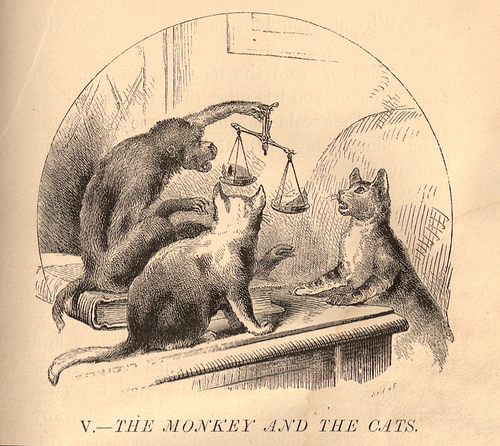
Two cats go to a monkey for justice and lose everything. Old Jataka tale. Can there be a 'honest' broker?

Fig. 6 Two cats go to a monkey for justice and lose everything. Old Jataka tale. Can there be a 'honest' broker?

The US can never ever be an honest broker anywhere, it's a Zioconned dead-end....with utter corruption and criminality....

What will be US role, if India and Pakistan were to sit down and resolve their issues. It is in US interest for instance, to create false stereotypes of Pakistanis. Let us examine some common notions about Pakistan.

Note how many multiples of Americans die each year from guns, than in Pakistan.

Yet English media selectively emphasizes the Pakistani deaths. Is the world likely to allow NATO and US, a free run of Af-Pak region, if it was declared that Pakistan suffered from tribal violence – on a scale smaller than gangsta and ghetto violence in USA.

Why does China and US renew their loyalty and friendship vows with Pakistan every week?

Nuclear nightmare, anyone?

US and its many think tanks have raised global consciousness on the dangers of Pakistani nukes falling in terrorist hands. Pakistan however sees it differently.

Pakistan’s nuclear weapons are probably quite secure from terrorists — the nukes are its crown jewels. The army cares about them in ways that it does not about bin Laden’s whereabouts or fighting the Haqqani network.

The nuclear issue looks different from Pakistan. For most of the world, the question is, can terrorists steal the nuclear weapons? In Islamabad it’s, can the United States or India steal them?

Kamran Khan, on his nightly Geo TV talk show, asked provocatively: “We had the belief that our defense was impenetrable but look what has happened. Such a massive intrusion, and it went undetected. … What is the guarantee that our strategic assets and security installations are safe?”

He was not wondering whether the nuclear weapons are safe from terrorists but from the U.S. (viaOpinion: Beware decline in Pakistani relations – Toby Dalton and George Perkovich – POLITICO.com).

The Taliban spokesman to Wall Street Journal had an even more interesting take on this issue.

The Taliban has no plans to attack Pakistan’s nuclear arsenal, its spokesman declared; The Taliban’s spokesman, Ehsanullah Ehsan, dismissed those concerns Wednesday as America’s “excuse” to pressure Pakistan’s government into fighting the Taliban, who he portrayed as the country’s true protectors.

“Pakistan is the only Muslim nuclear-power state,” Mr. Ehsan said in a telephone interview, adding that the Taliban had no intention of changing that fact. The Taliban, after all, aim to take over Pakistan and its weapons.

Mr. Ehsan’s remarks appeared tailored to appeal to that increasingly nationalist mainstream, where conspiracy theories flourish about American, Indian and Israeli plots to deprive Pakistan of its atomic arsenal. Pakistan’s nuclear capability is cherished here as the guarantor of safety from India’s far larger conventional military.

The Pakistan Taliban, an offshoot of the Afghan insurgent movement, have repeatedly tried to win public support by presenting themselves as a defender of Pakistan, though their attacks have killed thousands of Pakistanis. (via Taliban Say They Won’t Target Pakistan’s Nuclear Arsenal – WSJ.com).

How important is Islam?

The other question that bothers Indians is the anti-India, anti-Hindu, fundamentalist, radical Islamic Pakistani mindset? Whew. Did I miss anything?

Which raid-and-ravage regime would like to proclaim that their objective is raid-and-ravage? 60 years after being expelled from India, 200 years of loot on a historic scale, does Britain admit that they were here to loot and plunder India? Does Spain admit that they went to the New World to loot and enslave? All these looters needed a fig leaf to cover their raid-and-ravage operations. Religion was their cover.

Why expect Islamic raiders-and-looters to be different?

Moreover, for a raid-and-ravage party, to mislead the victim is a logical tactic. To hide a loot-agenda under a religious garb makes eminent sense for the looter. Does it make sense for us to accept their religious declaration at face value? Like we can see in the many raid-and ravage attempts.

Timurlane did not come here to convert Indians to Islam. After the raid-and-ravage attacks, Mahmud of Ghazni, Mohammed Ghori, Timur Lame, Nadir Shah did not stay behind to control their ‘conquests’. So too, in modern Pakistan. Jinnah used religion to get a Pakistan for himself – though he himself was completely irreligious. The Pakistani Army also uses religion – but is itself irreligious.

Similarly the Spanish did not go to America for Christianity – but for gold. Simple. The Spanish king told his conquistadores, ‘Get gold, humanely if possible, but at all hazards, get gold.” (1511, King Ferdinand).

The East India Company made piously declarations on how ‘the banner of Christ should wave triumphant from one end of India to the other’. But the real reason for the East India Company was raid-and-ravage.

Anuraag Sanghi on June 9, 2011
http://2ndlook.wordpress.com/2011/06/09/af-pak-the-coming-oil-bottleneck/

Like Alexander boasted of his conquest of India, many of these Islamic ‘conquerors’, also exaggerated.

Of course, Desert Bloc invented religion to create divisions, build a fifth column, in the ‘conquered’ people. Finally and initially, religion was the tool to use, many times the fig leaf too – but not the real cause for these rape-and-ravage adventures.

A 2ndlook at Pakistan

Pakistan is what Pakistan does.

Pakistan’s ability to keep its super-power allies on their toes is a remarkable diplomatic achievement. To remain a nuclear power, after near-universal condemnation and pressure reconfirms its diplomatic prowress. Pakistani leadership, from Jinnah onwards, have used the State and its institutions, for keeping a grip on power. That will continue.

What might change is the way power is shared. The Taliban may become a part of the Pakistani ruling class. How that will happen remains to be seen. A coup? Local elections, maybe. Electoral alliance? Pakistani power-equations are changing. How these equations work out, may surprise us.

Is India prepared? Ready?

Wednesday, October 05, 2011

No escape for Pakistan's Hazaras....


No escape for Pakistan's Hazaras....

By Abubakar Siddique and Khudainoor Nasar

QUETTA, Pakistan - A deadly attack in southwest Pakistan has added to the heavy toll suffered by a small Shi'ite minority amid a broad sectarian conflict.

The October 4 attack, carried out against a bus carrying mostly Hazaras on the outskirts of Quetta, claimed the lives of 12 people. There was no immediate claim of responsibility, but similar attacks against the community have previously been claimed by Sunnis affiliated with al-Qaeda and the Taliban.

Thousands have died in the ongoing conflict between rival hardline Shi'ite and Sunni sects in Pakistan, but the Hazaras have particularly suffered. The minority has been left reeling from a sharp increase in attacks in recent years, prompting some members to call on the government to provide more land to accommodate fresh graves.

Obtaining justice in the Sunni-majority state has proved elusive for some Hazaras like Rukhsana Ahmed Ali, a prominent political activist and social worker whose husband, Ahmed Ali Najafi, was killed at his workplace two years ago.

She says two eyewitnesses, young students of a religious seminary, said they heard the killers order her husband out of his car and asking them how he had wronged them.

"The killers then told him, 'You have not done anything wrong, but we have been told that killing one Shi'ite will open five doors of heaven for us,'" Ahmed Ali says. "He was then forced out of his car and killed by a whole burst of Kalashnikov fire."

'Are we humans or insects?'
Najafi's September 2009 killing marked the beginning of bloodshed against Hazaras centered in Balochistan province that has continued to this day. Hazara leaders claim that nearly 600 members of their community have been killed since 1999.

The Lashkar-e-Jhangvi, a banned extremist Sunni organization now seen as allied with al-Qaeda, has claimed responsibility for most of the attacks.

Middle-aged coal mine owner Sayed Nasir Ali Shah represents Quetta's Hazaras in the federal parliament. He was elected on the ticket of the governing Pakistan People's Party in 2008, but has since turned into one of its most outspoken critics. These days, his only mission is to try to save Hazara lives by calling for government protection.

Shah was undeterred even when he was targeted in a suicide attack last year, which left one of his young sons paralyzed. He says that protests and petitions with senior leaders have so far fallen on deaf ears.

"The government is only watching, and I am now tired after constantly shouting to grab their attention," Shah says. "I have been pleading for them to [do something to protect us] for God's sake. Are we humans or insects? We have no confrontation with our [neighboring] Balochi and Pashtun communities. We are targeted because our tormentors believe that we are infidels."

Losing battle
A century ago, Shah's Hazara ancestors fled the poverty and oppression of their Afghan homeland to the safety offered by Quetta, a British garrison town. Compared to their Afghan cousins, the Hazaras in Quetta prospered in British India and later on in Pakistan. But the tiny minority turned into a target for radical Sunnis.

Quetta once led the rest of Pakistan as an example of interfaith harmony. But Sunni extremism gradually gained traction in Balochistan's secular political culture and changed the landscape of its capital. This transformation was aided by Pakistan's alliance with radical Islamists who have fought its proxy wars in neighboring Afghanistan since the 1980s.

Abdul Khaliq Hazara, chairman of the Hazara Democratic Party, says the government had abdicated its responsibility of protecting his community. The small political party he leads hopes to provide protection to Quetta's 400,000 Hazaras by relentlessly advocating their rights.

He now sees no light at the end of the tunnel, and laments that many youths in the community are opting to seek asylum abroad.
"Nobody is listening to us - the parliament, Islamabad, the government in Balochistan, and our powerful [security] institutions," Khaliz Hazara says. "We feel that it's the government's policy to promote sectarian terrorism here. So that people keep on fighting each other because of sectarian tensions."

Balochistan, Pakistan's largest and least-populated province, is the scene of complex regional rivalries and home to many insurgent movements. The province has been destabilized by a separatist ethnic Balochi insurgency since 2004 that Islamabad is trying to crush militarily.

Insurgents' foothold?
Afghan and Western officials, however, are more concerned about the presence of Afghan insurgents in Balochistan. They blame Pakistan for sheltering the leadership of the Afghan Taliban movement in Quetta.

Police officials claim that the security environment in Balochistan is stretching their small force. Hamid Shakeel, a senior police officer in Quetta, says they always urge Hazaras traveling from Quetta to request police protection before embarking outside the provincial capital, often en route to Iran.

But there is only so much they can do, Shakeel says. "We only have 1,100 police officers for Quetta and their responsibility is not only to prevent target assassinations but they have to provide protection to senior officials," he says.

The situation prompted the Hazaras of Quetta to call for international protests this month. The Hazara Democratic Party is counting on Hazara diaspora communities to demonstrate in major cities across Europe, Australia and North America throughout October. A protest in Vienna on October 1 attracted hundreds of supporters, and the October 4 bloodshed prompted hundreds more to condemn the killings during a rally in London.

Back in Quetta, fear and uncertainty remain high. Mohammed Ismail, a Harzara trader, says that living a normal life in his once peaceful hometown is now impossible.

"When we leave our houses [in the morning] we are not sure about returning in the evening," Ismail says. "When our children go out into the bazaar, we are worried about something happening to them. These are the kind of problems we live with."


Tuesday, October 04, 2011

USA's ZOG is behind 'secession' plot in Hong Kong....?


USA's ZOG is behind 'secession' plot in Hong Kong...., and Hong Kong could peg to land.... ?
By Kent Ewing

HONG KONG - Fourteen years after this city's handover from British to Chinese rule, the United States has launched a secret plot to encourage Hong Kong to declare independence. Ultimately, the sinister aim is to undermine China's rise on the world stage and reassert US dominance in Asia.

That should have been last week's top news story around the globe, according to Hao Tiechuan, director general of the Department of Publicity, Culture and Sports of the Central Government's Liaison Office in Hong Kong. Then again, this is the same senior official who recently urged the people of Hong Kong to adopt a Beijing-prescribed program of national education in its schools because "brainwashing is an international convention".

In other words, anything Hao says or does should be regarded as suspect. Indeed, it is astonishing that he still has a job after all of his embarrassing miscues.

The worry, however, is that his clumsy, insuppressible honesty provides a window into official thinking behind the scenes. Otherwise, why does he hold such an important position? And why hasn't he been summarily sacked for his loose tongue?

Hao's comments - which, remarkably, he posted (and then deleted) last Wednesday on Sina Weibo, the Chinese version of Twitter - followed on the heels of an unusually emotional outburst about US meddling in Hong Kong affairs from the Commissioner's Office of China's Foreign Ministry in Hong Kong.

Responding to WikiLeaks' release of nearly 1,000 unedited US State Department cables about Hong Kong, an office spokesman accused American diplomats of contravening international law through their brazen interference in Hong Kong affairs.

"The conduct of the US has gone beyond the functions that are stated in the Vienna Convention on Consular Relations and other international laws," the official China Daily quoted the unidentified spokesman as saying. "We have justification to be concerned and discontented. We demand that the US stop erring."

A China Daily commentary, written by staff writer Bob Lee and published in the paper's Hong Kong edition, added fuel to the fire.

"In the 14 years since the handover of Hong Kong to its motherland," Lee wrote, "there has been much speculation about 'a second governing body' running Hong Kong. Now, thanks to the release of unedited US State Department cables by WikiLeaks/CIA ... the whole truth has come out in the wash."

Lee then gives the address of this anti-Beijing "task force" as 26 Garden Road, where the US consulate is located.

Lee and the Foreign Ministry's local office are upset because the cables show American diplomats have engaged in regular dialogue with Hong Kong political leaders and judges who sit on the city's Court of Final Appeal. Lee even goes on to name a Hong Kong "Gang of Four" - former chief secretary Anson Chan Fang On-sang, founder of the Democratic Party Martin Lee Chu-ming, media tycoon Jimmy Lai Chee-ying and Cardinal Joseph Zen Ze-kiun, formerly the Vatican's Bishop of Hong Kong - whom he says are the most welcome and regular invitees to consular luncheons and meetings and thus clearly conspirators in the American plot to stoke trouble here.

It seems strange, however, that a local office and a China Daily commentator should react so stridently to the cables while officials in Beijing have yet to comment on them - probably because the "secrets" they reveal don't add up to much.

The cables cover a wide variety of topics - from education to water supplies to speculation about who might become the city's next chief executive - but they contain nothing that is damning or even very surprising. Surely, Beijing cannot be taken aback by the news that present US Consul General Stephen Young and his underlings hold occasional meetings with Hong Kong's movers and shakers.

In the most interesting revelation contained in the cables, Justice Kemal Bokhary is quoted as saying that he and the four other judges on the Court of Final Appeal, "seriously considered resignation" after a landmark court ruling was overturned in 1999 by the Standing Committee of the National People's Congress (NPC).

The court had ruled that mainland children born before their parents became permanent residents of Hong Kong were entitled to right of abode in the city, triggering fears that a flood of migrants would overwhelm Hong Kong's schools and social welfare system.

According to the cable, dated August 28, 2007, the judges decided against resignation because they "feared they would be replaced by less independent or competent jurists".

While the date of the cable demonstrates that Bokhary was still gnawing on his resentment nearly eight years after the NPC Standing Committee's reversal of the court's judgment, its contents should surprise no one. The five judges were outraged and irate; in effect, the NPC Standing Committee had just stricken the all-important word "Final" from the court's title.

Another cable recounts remarks made in 2005 by chief executive Donald Tsang Yang-kuen to then US consul general James Cunningham about the disadvantages of implementing a fully democratic political system in Hong Kong, where more than half of a population numbering 7.1 million pays no tax.

"The great fear in Hong Kong," the chief executive is quoted as saying, "is not taxation without representation, but representation without taxation, in which the non-taxpaying majority would dictate to the taxpayers."

In another cable, a prominent local political commentator, Albert Cheng King-hon, criticizes as "incompetent" then chief secretary Henry Tang Ying-yen, who stepped down from his position last week to mount a campaign to be the city's next chief executive; Tang is considered Beijing's favored candidate to succeed Tsang and thus the frontrunner at this point.

Yet another reveals the worries of James To Kun-sun of the Democratic Party that Beijing has infiltrated the party with spies.

All this may be mildly titillating, but it is hardly big news and certainly nothing to go diplomatically apoplectic about.

If the reaction to the WikiLeaks release by the Foreign Ministry's local office rattled American consular officials and those named in the cables, Hao's cyber rant left them positively dumbfounded.

"Many mainlanders do not know that forces like the US have been attempting to use Hong Kong as a bridgehead to contain the rise of China," Hao wrote on Weibo. "They don't hope for China to attain democracy and the rule of law. They just want China to fall into turmoil."

Hao went on to accuse current US consul general Young, formerly director of the American Institute of Taiwan, of using his bloated staff of several hundred employees to foment a secessionist movement in Hong Kong.

"What are they doing in such a tiny place as Hong Kong?" Hao fumed. "They intend to stir up trouble in an attempt to secede the city from China. What kind of person is US consul general Stephen Young? He is an old hand who engaged in instigating Taiwanese independence and secession in eastern European countries."

While crazy posts like this are standard fare in the Chinese blogosphere and elsewhere on the Internet, they don't usually come from senior officials carrying sensitive diplomatic portfolios. Yes, they were deleted, but how could a person in Hao's position have posted them in the first place?

Clearly, Hao needs to go. He is an embarrassment who is only doing damage to the central government's reputation in Hong Kong and beyond.

More broadly, Chinese officials - among whom maybe Hao stands as a lonely extreme - need to rise above their increasingly inexplicable paranoia about Hong Kong and the West. It is safe to say that diplomats stationed at Chinese embassies and consulates the world over are also talking to local leaders about the important issues of the day - as they should be - without being accused of contravening international law.

These 960 cables show that's all American officials are doing here. If there are more sinister things going on, they are not represented in the documents released by WikiLeaks/CIA so far....LOL

Hong Kong is part of China now. That's not going to change, and a vast majority of the people here - including local pan-democratic politicians and visiting American diplomats - do not want it to change.

Hong Kong needs China. The US needs China. The world needs China.

There's less and less to be paranoid about....LOL


Hong Kong could peg to land....
By Chris Cook

The discovery of the platypus in Australia created something of a dilemma for zoologists. Some said that as a furry warm-blooded animal the platypus should be classified as a mammal: others held that because the platypus reproduces by laying eggs then it should be classified as a bird or a reptile. The solution was to create a new classification especially for the platypus.

Hong Kong is also in a class of its own as a monetary platypus which uniquely has no Central Bank as a lender of last resort. Supervised by the Hong Kong Monetary Authority, Hong Kong's banks clear payments among themselves "real-time".

Hong Kong is also a fiscal platypus, uniquely gathering a large proportion of government income from the use value of land. Very few countries have used land rental value as a fiscal basis to the same extent as Hong Kong, and those few which have - such as Denmark - have typically levied a local tax on land rental values.

Hong Kong gathered income through the creation and sale of long leases of public land. The resulting "Crown Rentals" collected from property developers had the effect of reducing the amount of taxation to be collected from Hong Kong's entrepreneurial businesses and citizens. However, over the years the amount raised from the sale of long leaseholds has been reduced considerably - to the advantage of developers - through decreasing the discount rate applied in calculating the lease premium.

Evolution
Hong Kong is, like the platypus, an evolutionary oddity, with a track record of rapidly evolving its monetary and fiscal architecture in response to external circumstances. This is due in no small part to an extremely flexible and talented cadre of officials in the relevant policy making institutions.

From 1935 to 1972 the Hong Kong dollar was pegged to sterling through a currency board arrangement, but the US dollar gradually supplanted sterling as a global reserve currency, and in late 1974, after a brief flirtation with a US dollar peg, Hong Kong let the local dollar float against other currencies without any formal intervention.

Since 1983, after a crisis in confidence, the Hong Kong dollar has once again been pegged to the US dollar within the Linked Exchange Rate System (LERS), which has two mirror image - strong side and weak side - defenses against capital inflows and outflows.

  • Strong side defense at 7.75 HK$: upward pressure on HK$ > Currency Board sells HK$ > monetary base expands > interest rates fall > downward pressure on HK$.
  • Weak side defense at 7.85 HK$: downward pressure on HK$ > Currency Board buys HK$ > monetary base contracts > interest rates rise > upward pressure on HK$.

    Decline of the dollar
    The US Federal Reserve Bank responded to the credit crisis in 2008 by reducing dollar interest rates to zero, and by printing trillions of dollars and using them to buy financial assets. These monetary policies have had two adverse effects on Hong Kong.

    Firstly, risk averse investors - not speculators in search of a transaction profit - have been making financial purchases of commodities using vehicles such as Exchange Traded Funds. These inflation hedgers have perversely caused the very inflation they sought to avoid, and Hong Kong citizens have been particularly hard hit in respect of essentials such as food and energy prices.

    Secondly, the low interest rates necessitated by the peg have exacerbated property price inflation. Several international investors take the view that the Hong Kong dollar is overvalued against the US currency by around 30% and are placing major financial bets to that effect. In their view, the question is not whether or not the peg arrangements will be changed, but when; and - the $64 billion question - to what?

    Triffin's dilemma
    The economist Robert Triffin identified that where a global reserve currency is backed by interest-bearing debt - such as the US dollar, and sterling before that - then the result is that the issuer of that reserve currency will eventually become unsustainably indebted to the rest of the world.

    In order for China to become the global reserve currency, and suitable for a Hong Kong currency peg, it would mean that China would not only have to cease its mercantilist export policy but also reverse this into a massive trade deficit.

    Such a cosmic shift in Beijing's business model is sufficiently unlikely that the well publicized bet of Bill Ackman's Pershing Square Capital - that the Hong Kong dollar will appreciate and adopt a yuan peg - appears to be an extremely long shot.

    But if Ackman's thesis is accepted that the dollar peg is no longer sustainable, what other basis for the currency might there be?

    The global tidal wave of money in search of a safe haven has forced the Swiss Franc (CHF) to levels which gravely threaten Swiss exports. The Swiss National Bank recently surprised the financial world by capping the appreciation of the CHF against the euro at a level of 1.20 euros. But the innovation which blew away the speculators was the announcement by the SNB that it would defend the cap simply by creating CHF and exchanging this money for foreign assets (and hence currency) without conventionally backing ("funding") this money with government debt.

    The Swiss thereby demonstrated that on the "strong side" they could defend the CHF against appreciation by printing - or even threatening to print - infinite amounts of CHF and exchanging these for foreign assets or currency.

    The monetary orthodoxy is that this will cause inflation in Switzerland. This is true only to the extent that the overseas holders of the currency are permitted to buy Swiss assets such as real property and stocks. Overseas holders of CHF do not typically spend them on Swiss domestic consumption to potentially cause retail price inflation.

    This unorthodox monetary action by the Swiss blew away the myth that money must necessarily be backed by debt. The truth is that both central and private banks are simply middlemen - credit intermediaries - between people and government. Modern fiat money is backed by the ability to use it to pay taxes, which in most countries are largely levied upon productive people rather than productive assets.

    A simple but radical monetary and fiscal evolution for Hong Kong now enters the realm of the adjacent possible: land-based money.

    Back to the land
    Land backing for bank created money is not a new idea. The remarkable Scottish gambler and adventurer John Law proposed a land-backed currency for Scotland in 1705, based upon central bank credit creation and backed by loans secured against leases.
    Unfortunately, when he applied his monetary expertise in France in 1719 he created not only the first recognizably modern central bank - the Banque Royale - but also the first asset price bubble driven by bank credit. The land rights owned by his Mississippi Company over a third of the US land mass were not then worth what they are now, and Law ruined himself and France in the Mississippi Bubble.

    The absence of a central bank in Hong Kong opens up the possibility of a more direct - "peer to asset" - approach. As freeholder, the government could declare a new ground rental on the unimproved value of Hong Kong land and then base the Hong Kong dollar on this value simply through the creation and issue of credits redeemable in payment for HK$1.00's worth of rental.

    The first fiscal effect of this ground rental would be to reduce speculative development pressure. Secondly, the resulting HK Rental Pool may then be distributed equally to all Hong Kong citizens as a land dividend. The effect of this would be of a net fiscal transfer from those with above average exclusive use of Hong Kong's scarce land to those with below average use.

    Finally, under suitable management by service providers and supervision by the Hong Kong Monetary Authority, this new source of HK public credit would be available to finance new infrastructure. Such public investment would increase the ground rental value of the relevant land and enable the public credit to be retired and recycled out of the increase.

    This land dividend would reduce the financial pressure on Hong Kong's poorest citizens and would do so through a pre-distribution of future wealth rather than a re-distribution of existing wealth. Properly executed - and Hong Kong's executive are more likely than most to succeed - this fiscal policy should be win/win: the rich would in future receive a smaller share of a larger pie.

    The monetary effect of a land-based HK dollar would be of a currency with exchange control hard-wired into it. Overseas holders could exchange the HK dollar for other value with HK residents and businesses, but they would never be able to redeem it against HK rentals unless they resided in Hong Kong.

    This simple and radical concept of a land-based Hong Kong dollar would see the evolution of Hong Kong's two monetary and fiscal platypi into a new and resilient 21st century financial animal, still in a class of its own.
  • .


    Friday, September 30, 2011

    Obama's assassination of a U.S. citizen calls into question presidential authority and where this new slippery slope ends....


    Obama's assassination of a U.S. citizen calls into question presidential authority and where this new slippery slope ends....


    http://www.forbes.com/sites/harveysilverglate/2011/10/06/obama-crosses-the-rubicon-the-killing-of-anwar-al-awlaki/


    U.S. drones kill U.S. citizen Anwar al Awlaki in Yemen...

    October , 2011 -- Unnamed Pentagon sources are confirming that it was an attack by U.S. drone aircraft that killed the alleged head of "Al Qaeda in the Arabian Peninsula" Anwar al Awlaki in Marib province in the eastern part of north Yemen. Al Awlaki was born in Las Cruces, New Mexico in 1971, attended Colorado State University where he graduated in 1994 with a bachelor's degree in civil engineering. Al Awlaki also served as a imam at a Denver mosque and as president of the Denver Islamic Society.

    Never having been cited by the U.S. government as much more than being an "inspiration" for those who carried out terrorist attacks at Fort Hood, Texas; the 2005 London transit bombings; a failed "underwear" bombing of a passenger plane en route from Amsterdam to Detroit; a dubious case involving Muslims who were said to be planning a terrorist attack at Fort Dix, New Jersey; and a failed bomb set to detonate in Time Square in New York, al Awlaki was named a "specially designated global terrorist" and his assassination was personally ordered by President Barack Obama in early 2010. In October 2010, Representative Anthony Weiner (D-NY) called on YouTube to remove hundreds of al Awlaki's videos from its website, charging that they inspired terrorists. Weiner later resigned in disgrace after lewd photos that he sent to several women surfaced on the Internet.

    Like Obama, who claimed Indonesian citizenship to receive a foreign scholarship at Occidental College in Los Angeles in 1979, al Awlaki claimed Yemeni citizenship when he obtained a foreign student scholarship to attend Colorado State in 1991. During his summer breaks at college, al Awlaki trained with CIA- and Saudi-backed mujaheddin guerrillas in Afghanistan. Al Awlaki later earned a Master's degree from San Diego State University and he was enrolled in a doctorate program at George Washington University in Washington, DC from January to December 2001. Al Awlaki also served as the Muslim chaplain at George Washington University.

    A few months after the 9/11 attacks, Al Awlaki was invited to a luncheon at the Office of General Counsel in the Secretary of Army's office at the Pentagon. The invitation was part of a Pentagon initiative to reach out to moderate Muslims. At the luncheon, where some attendees were hostile to al Awlaki, he condemned "Al Qaeda" and the 9/11 attacks. Al Awlaki also wrote on the website IslamOnline.net six days after the 9/11 attacks that he believed they were carried out by Israeli intelligence agents, a view shared by a number of U.S. and foreign intelligence and military experts, a number of whom are non-Muslim and some of whom worked at the Pentagon at the same time of al-Awlaki's luncheon meeting. In 2002, al Awlaki was the first Muslim cleric to conduct a prayer service at the U.S. Capitol. Citing a climate of fear among American Muslims, al Awlaki left the U.S. for Britain at the end of 2002.

    In 2004, al Awlaki returned to Yemen. His father, Dr. Nasser al Awlaki, received a Master's degree at New Mexico State University on a Fulbright Scholarship and a doctorate at the University of Nebraska. Dr. al Awlaki later served as Agriculture Minister under Yemeni President Ali Abdullah Saleh and, subsequently, as president of Sana'a University. The Awlakis are related to Yemeni Prime Minister Ali Muhammad Mujawar, who, along with Saleh, was seriously injured in a rebel bombing attack on June 3.

    Obama's decision to order the assassination of al Awlaki, a U.S. citizen, has met with opposition from constitutional rights groups and experts. However, there is another aspect of the al Awlaki assassination that should serve as a stark warning to American journalists. In May, while attending the Arab Media Forum in Dubai, this editor was afforded an opportunity by a Yemeni television news producer to travel to Yemen and meet with al Awlaki. Following a flight to Sana'a from Dubai, the meeting with al Awlaki would have been arranged by his father and would have taken place in a secret location in the Yemeni mountains east of Sana'a and after a thorough vetting process by al Awlaki's followers, including a vigorous pat down for geo-location devices. With al Awlaki designated as Public Enemy Number 1 by the Obama White House, the CIA, and just about every other U.S. intelligence and law enforcement agency, I declined the invitation. However, given the fact that reporters for CNN and ABC News met in secret locations in Afghanistan with Osama Bin Laden in 1997 and 1998, respectively, there was a precedent for journalists meeting with those designated as "most wanted" by the United States government. Al Awlaki, a U.S. citizen ordered murdered by the President of the United States, was a much different case than Bin Laden and just as, if not more, newsworthy than Bin Laden for an American readership.

    Had I taken the Yemeni producer up on his offer and met with al Awlaki at the same time that U.S. drones launched their attack, Obama would have been responsible for the murder of more than one American citizen. Obama's decision to assassinate American citizens without due process and according to the Constitution he swore to uphold becomes much more problematic when "collateral damage" to other Americans enters into the picture.

    Now that Obama has taken the step to assassinate an American citizen, where does this "slippery slope" end?

    There is also the information that al Awlaki has taken to the grave -- information that may have been gleaned from a personal interview had I opted for one. What information did al Awlaki have about Israel's involvement in 9/11? Who were his interlocutors at the Pentagon? Who were his CIA contacts while fighting with the mujahidin in Afghanistan. As to the first question, Obama's friends in Jerusalem perhaps have much more to celebrate today than they did last week when Obama sold out Palestinian independence for some big political donations from Wall Street and Hollywood.

    UPDATE 1X: After the report of al Awlaki's assassination by American drone strikes in Yemen, it is being reported that a second American citizen, Samir Khan, a Riyadh-born Pakistani-American from Charlotte, North Carolina, was killed in the same drone attack. Khan was said to be the publisher of the English-language "Inspire," an "Al Qaeda in the Arabian Peninsula" magazine that recently criticized Iranian President Mahmoud Ahmadinejad for suggesting that the 9/11 attacks were an "inside job" by the U.S. government. "Inspire's" stance on 9/11 as the work of "Al Qaeda" matches up completely with those of the Obama administration and Israel and its global lobby.

    "Inspire" has come under suspicion that it was a propaganda tool of the CIA and/or Mossad used to keep "Al Qaeda" relevant as the Arab Spring movement rejects Al Qaeda's jihadist doctrine. "Inspire" debuted in July 2010. "Inspire" was first brought to the media's attention by the Washington-based Search for International Terrorist Entities (SITE), a known tool of Israel's Mossad..., CIA and the infamous White House Murder INC,.....


    Friday, September 23, 2011

    The infamous White House Murder INC, assassinates Burhanuddin Rabbani....


    The infamous White House Murder INC, assassinates Burhanuddin Rabbani....


    http://chagataikhan.blogspot.com/2010/03/ronald-reagn-afghan-mujahideen-talibans.html

    The Taliban’s statement denying involvement in the killing of Burhanuddin Rabbani, head of the Afghan High Council for Peace, is coming on the third day of the incident. Evidently, Quetta Shura thoroughly checked out with the various Taliban factions before coming out with this statement. Indeed, Taliban, uncharacteristically enough, was not on message this time. They are normally the first with a claim, but this time they weren’t.

    A Guardian editorial, too, makes this important point: “Rabbani’s scalp would have been high on the target of the Taliban, who have turned to killing senior Afghan leaders, but for the fact that he was also the head of the high peace council. Bombing him would be akin to bombing the talks themselves, and there was no suggestion from the Taliban leadership that this is their aim.”

    Indeed, Taliban supremo Mullah Omar’s recent Eid message was widely interpreted as signifying a change of time, signalling that the future of the insurgency could lie in politics. A commentary by Ahmed Rashid is here. Another commentary by the US-funded Radio Free Europe / Radio Liberty virtually echoing Rashid’s mind is here.

    A number of theories have appeared on who killed Rabbani, adding to all-round confusion, and the only good thing is that the needle of suspicion is moving by the day further and further away from the Taliban. But then, someone did order Rabbani’s killing, isn’t it? Who was it?

    Continue digging deeper and deeper, and don’t allow oneself be distracted by the US’s drum-beating or sabre-rattling against Pakistan.

    PM Manmohan Singh’s statement spoke volumes. He refused to rush to judgment as to whose hand it is that is red with Rabbani’s blood. Let me quote his message to Karzai:

    “It is with great shock and sadness that I have learnt of the tragic death of Professor Burhanuddin Rabbani. This is a senseless act of terrorism which the Government and people of India condemn. I fondly recall my two meetings with Professor Rabbani in Kabul in May 2011 and in New Delhi in July 2011 during which he had shared with me his vision of peace and reconciliation in Afghanistan. The best tribute the people of Afghanistan can pay to him is to carry on with the task that he had begun — securing a peaceful and safe future for the people of Afghanistan. Please accept my deepest condolences on the tragic loss. I wish to assure Your Excellency that India stands by you and the people of Afghanistan in this hour.”
    Maybe, PM will inquire from Iranian President Mahmoud Ahmedinejad when they meet in New York this week. Tehran is very well clued-in as to what is happening in the name of the war on terror in Afghanistan. Besides, Tehran was Rabbani’s very last port of call, from where he headed for Sharjah to spend a few days with his family members who live there.

    That is, until he was asked to rush back to Kabul by an Afghan official who conveyed a message from the US and British embassies in Kabul that they had something of extreme importance to discuss with him urgently and he should get back. Which he, alas, did.

    The Iranians would know what was on Rabbani’s mind as he walked into the sunset. Most certainly, Ambassador Mohsen Pak-Ayeen would be one of them who spent time chatting up Rabbani in Tehran. That was one of the two reasons why what Ambassador Pak-Ayeen said caught my attention.

    The second reason was that he was my Iranian colleague when I served as ambassador in Tashkent. Those were the tumultuous days of the Northern Alliance and the anti-Taliban resistance. Ambassador Pak-Ayeen and I became great friends — and, boy, don’t I know if there is one diplomat in our region who knows Afghanistan like the back of his hands, it is him, it is him. What he said is here.

    .

    Deconstructing the death of Rabbani....
    By M K Bhadrakumar

    Afghans invariably had a twinkle in their eye when the "Ustad" came up in conversation. It was mirthful and respectful, it spoke of familiarity bordering on affection for a patriarch who was capable of frailties. Burhanuddin Rabbani was incomparable in the pantheon of Afghanistan's jihadi heroes.

    Rabbani, 71, former president and head of the Afghan Peace Council, was assassinated in his Kabul home by a suicide bomber on September 20.

    Rabbani evoked respect as an Islamic scholar, while his jihadi pedigree was impeccable. He was admired for the ease with which he criss-crossed Afghanistan's political and ethnic divides although he remained the tallest Tajik leader. Rabbani could be ruthless, but then, he was also incapable of guile and animosities. He amused onlookers with his vanities and his weakness for pomp and flattery.

    But he was feared for his political skills and could also be fickle-minded to the point of being unreliable. Above all, he was widely respected as an Afghan nationalist.

    Rabbani was a man of many parts. Unlike his Jamiat e-Islami (Islamic Society of Afghanistan) commander, Ahmad Shah Massoud, who remained in Panjshir through the Afghan jihad in the 1980s, Rabbani was based in Pakistan and was one of the "Peshawar Seven" during the jihad of the 1980s against the Soviets. This necessitated, or enabled, him to forge a close working relationship with Pakistan's military and security establishment.

    This was so much so that when bitter rivalries over the leadership of the mujahideen government in Kabul erupted in early-1992, then-Pakistani prime minister Nawaz Sharif anointed him as "interim president".

    However, Rabbani became so accustomed to the presidency that he wouldn't vacate it as he had earlier vowed to do, and Islamabad tried all the tricks in its bag but couldn't dethrone him. Unsurprisingly, some bitterness followed when the Taliban forcefully drove him out of Kabul and seized power in 1996.

    But a cordial relationship resumed nonetheless when after a lap of absence he visited Islamabad in his new capacity with the High Peace Council (entrusted with the mission to reconcile the Taliban). Pakistan's army chief Parvez Kiani hosted him in General headquarters in Rawalpindi as a mark of honor to someone, who, despite the ebb and flow of time, remained a familiar figure, after all.

    Karzai is the 'loser'
    Any attempt to deconstruct Rabbani's assassination should begin with a detached look at the bonds between him and Pakistan's military leadership. No doubt, it was a complex relationship, enriched by Rabbani's networking with the "Islamic" parties in Pakistan and the various jihadi elements in the region and beyond as well as with Pakistan's Inter-Services Intelligence (ISI).

    Conceivably, Kiani saw Rabbani (an ethnic Tajik) as a potential interlocutor who could help Pakistan reach out to the non-Pashtuns, especially the Panjshiris. Rabbani had complicated equations with Massoud and the Panjshiris, and there were acute moments when the two sides barely tolerated each other.

    What helped was that without Rabbani as figure-head, the Shura-e-Nazar - the supervisory council created by Massoud in 1984 that comprised about 130 commanders from 12 northern, eastern and central regions of Afghanistan - would have remained provincial. Massoud needed Rabbani politically, and the Ustad lacked military skills while the commander made up for it.

    Again, his excellent ties with Iran, his sagacity to keep lines open to the Taliban, his virulent "anti-Americanism" - these were also of interest to Pakistan, whose military leadership showed pragmatism by accepting him as the point person in intra-Afghan dialogue. Pakistan assessed that if any non-Pashtun leader had a chance of bringing the Northern Alliance groups on board the reconciliation process and a broad-based settlement, it was Rabbani.

    Suffice to say, the repercussions of Rabbani's assassination for Pakistan could be serious. One, the hawkish Panjshiris and other intransigent Northern Alliance groups will use Rabbani's death to block any accommodation with the Taliban, which indeed would mean a disastrous slide toward civil war.

    Two, against the backdrop of the US-Pakistan standoff, an axis might develop at some point between these intransigent Northern Alliance elements and the United States on the basis of a congruence of interests. (The Northern Alliance suggested such an alliance in the immediate aftermath of 9/11.)

    Equally, a polarization would further isolate President Hamid Karzai. The US agenda to corner Karzai receives a fillip in these changed circumstances. The deck gets cleared now for the US to mop up residual issues relating to the strategic agreement that it is keen to conclude before a peace conference begins in Berlin in December.

    With the non-Pashtun Northern Alliance groups in rebellious mood, Karzai will have a hard time carrying forward the dialogue with the Taliban. He cannot easily find a replacement for Rabbani. The credibility of the High Peace Council was never really high, and it is literally in tatters today.

    Besides, Karzai needs to focus on his own political survival as his isolation after the murder of his half-brother Wali Karzai becomes acute. His opponents in parliament challenge his constitutional authority; the government's functioning has suffered and the president is unable to get his cabinet posts filled.

    On the other hand, he is pilloried for being "ineffectual" and an impression has been created that while he remains in office, the drawdown of US troops is hard to implement on the ground. It is actually more than a blame game.

    The 'unknown unknown'
    The US prefers to directly handle the reconciliation process with the Taliban and set its terms, without involving Karzai (or Pakistan). Surely, the biggest gain for the US from Rabbani's departure is that the idea of the "Afghan-owned" peace process that Karzai spearheaded (which Washington never really favored) has floundered for all practical purposes.

    In sum, deconstructing the death of Rabbani produces strange patterns. Those who "gained" include the intransigent Northern Alliance groups and the "alien mercenaries of organized terrorism", as Iranian President Mahmud Ahmadinejad pithily described. What is certain is that Karzai "lost" heavily. He needs to figure out a way forward. Pakistan is pressing him to pick up the threads and resume the joint Afghan-Pakistani peace process.

    Some fingers have pointed at Pakistan for being responsible for Rabbani's murder - principally, these are irate Northern Alliance elements ("warlords") who are jostling for political space and are openly courting foreign sponsorship. The US, which is piling the pressure on Pakistan, refrained from linking the ISI with Rabbani's murder - the Taliban have denied involvement.

    In Rabbani's last interview - with a Russian television channel - he admitted that he was skating on thin ice. The following excerpts become significant:
    I cannot say that [Taliban leader] Mullah Omar has agreed to participate in the peaceful negotiations, or that he has denied this possibility completely ... the Taliban leadership has trends towards peace, and these trends do have a certain power. They realize that the country's security is in their interests as well.

    No doubt, presently there are divisions within the Taliban leadership operating in the country as well as beyond ... We understand that there are issues within the movement, and there are certain forces that can cause problems ... Some forces intend to undermine the peaceful process and the negotiations with the Pakistani government.

    Certainly, the people of Afghanistan do not want foreign troops to remain ... and we don't want our nation's security to depend upon a foreign military presence. It is unacceptable ... However, considering the critical security situation in our country, the lack of stability and the continuing armed clashes, we have to tolerate the foreign military presence.

    We have received assistance as well as certain commitments from the countries of the region, especially Pakistan, and we expect it to start making some practical steps ... The biggest challenge ... is the issue of representation of negotiators and, again, a lot depends upon Pakistan's attitude ... As soon as the government of Pakistan decides that it is time to seriously tackle the issue of peace in Afghanistan and undertake the task of providing their assistance and protection to our country, I'm sure the peace process will be out of the deadlock.
    It was a candid interview. Rabbani wasn't sure Mullah Omar was in the peace process, nor was he sure the Taliban supremo was rejecting it - the "unknown unknown", as former US defense secretary Donald Rumsfeld would say.

    Rabbani said the Afghan people opposed foreign occupation, but he justified the US military presence and sidestepped the reality that the military presence was part of the problem. He hinted there were forces that resented his dealings with Pakistan, but he complained that Pakistan wasn't yet cooperating with the peace process - although it had mastery over the insurgents. Rabbani knew that a shroud of strategic ambiguity was inexorably surrounding him and the peace process.

    The intriguing part is where he stood vis-a-vis the US, finally. His "anti-Americanism" was apparently mellowing, but his last port of call was Tehran. He juggled far too many balls in the air, which in today's Afghanistan meant inviting trouble - even for an Ustaz....